


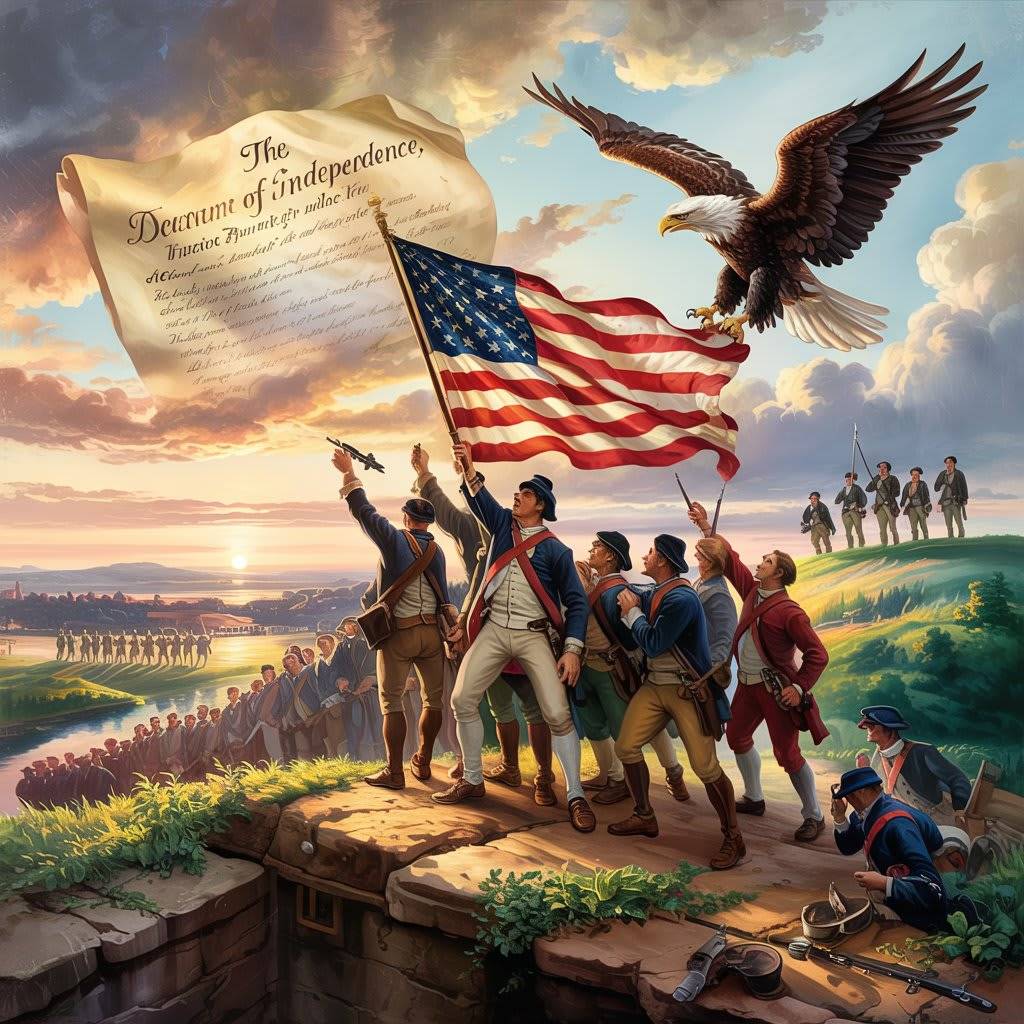
The summer of 1776 was hot, uncertain, and alive with the tension of change. Thirteen colonies stretched along the eastern seaboard of North America, each with its own customs and governance, but united by a growing resentment against the British crown. For years, these colonies had watched their rights diminish under the weight of British taxation, military presence, and laws made thousands of miles away by a Parliament where they had no voice. It was not just about tea or stamps—it was about the fundamental right to determine their own destiny.
The spark had been smoldering since the end of the French and Indian War in 1763. Britain, facing massive war debts, began taxing its American colonies heavily. The Stamp Act, the Townshend Acts, and the infamous Tea Act were seen not just as economic burdens but as chains tightening around the colonies’ freedom. Protests turned into boycotts. Boycotts turned into riots. The Boston Massacre in 1770 and the Boston Tea Party in 1773 became symbols of a people who would no longer be ruled without representation.
As resistance grew, so did the crackdown. Britain responded with force, sending troops to enforce order and discipline. But the colonies were no longer willing to be disciplined. In April of 1775, gunfire broke out in Lexington and Concord, Massachusetts. Nobody knows who fired the first shot, but it echoed across history. The American Revolution had begun.

In the months that followed, the Continental Congress gathered in Philadelphia. These were men of different backgrounds—farmers, lawyers, merchants—but they shared a vision of liberty. In June 1776, they entrusted a young Virginian named Thomas Jefferson with drafting a formal declaration that would explain to the world why the colonies sought independence.
Jefferson’s words were bold, clear, and revolutionary. “We hold these truths to be self-evident,†he wrote, “that all men are created equal, that they are endowed by their Creator with certain unalienable Rights...†This was not just a rejection of British rule—it was a rebirth of what it meant to be governed.
On July 2, 1776, the Congress voted in favor of independence. Two days later, on July 4th, they formally adopted the Declaration of Independence. That date would become a symbol, not just of separation from Britain, but of unity among the colonies and hope for the future.
The news spread quickly. In New York City, General George Washington ordered the Declaration read aloud to his troops. Crowds gathered and tore down a statue of King George III, melting it down into bullets. The war would still rage for seven more grueling years, but July 4th gave the cause a soul.
The path to freedom was not easy. The British army was one of the most powerful in the world. The Americans were under-equipped, under-trained, and outnumbered. But what they lacked in resources, they made up for in spirit. They fought not for a king, but for a principle—the right to live free.
Over the course of the war, countless ordinary people became heroes. Farmers left their plows, blacksmiths put down their hammers, and women stepped in to support the cause as spies, nurses, and leaders on the home front. The revolution was not won by statesmen alone; it was won in the hearts of everyday people.
In 1781, with the victory at Yorktown, the tide turned permanently. Two years later, the Treaty of Paris was signed, and the United States of America was officially recognized as an independent nation.
But Independence Day is not just about a document or a date—it is about an idea. An idea that people can govern themselves. That liberty is worth the fight. That all are created equal, even if that promise has taken generations to be fully realized.
Each year on the Fourth of July, fireworks light the sky in memory of that daring moment when thirteen scattered colonies stood together and declared they would be free. The celebration is not just of a past victory, but a continual reminder of the courage, sacrifice, and vision it took to give birth to a nation.
As flags wave and anthems rise, we remember that freedom is not inherited—it is earned, protected, and passed on. The story of America’s Independence Day is not just history; it is a living legacy.