



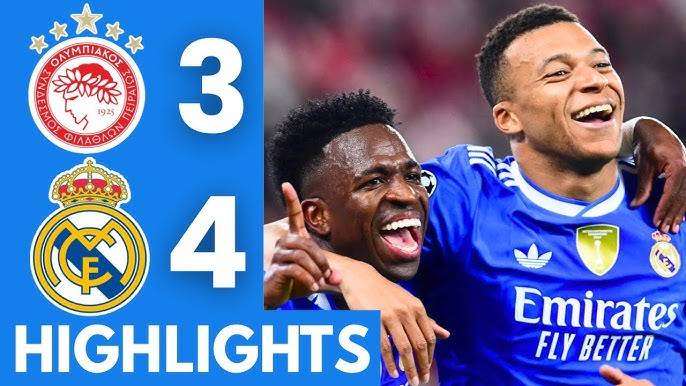
I. Executive Summary: The Four-Goal Phoenix Rises in Piraeus
Real Madrid secured a necessary and pivotal 4-3 victory over Olympiacos Piraeus in a dramatic UEFA Champions League League Phase Matchday 5 fixture at the hostile Georgios Karaiskakis Stadium.
The defining element of the evening was the performance of star striker Kylian Mbappé. The French international delivered a sensational four-goal haul—a "poker"—which included the second-fastest Champions League hat-trick ever recorded, completed in a blinding 6 minutes and 42 seconds.
While the immediate success relieves pressure on the management and squad, the manner of the victory underscores the team’s current reliance on sheer individual brilliance. The 4-3 scoreline and the frantic closing stages, where Olympiacos (ranked 33rd in the league phase) created multiple opportunities to equalize
II. Pre-Match Context and Strategic Blueprints
A. The Pressure Cooker: Madrid's Slump and Alonso's Challenges
Real Madrid entered the match under mounting pressure following a stretch of inconsistent results, including a UEFA Champions League loss and two subsequent draws in La Liga, constituting a three-game winless streak.
The strategic challenge for Madrid was compounded by a significant injury crisis. The defensive line was heavily depleted; goalkeeper Thibaut Courtois was ruled out due to a viral infection, and the squad was missing several key personnel, forcing structural reshuffling. Aurélien Tchouaméni was required to play defensive midfield, and Raúl Asencio was one of the few central defensive options available.
B. Olympiacos’ Defiant Setup and Home Ambition
Olympiacos, under the guidance of coach José Luis Mendilibar, whom Alonso holds in high regard
Tactical analysts correctly predicted that Olympiacos would employ a pragmatic and resilient defensive approach, likely deploying a disciplined 4-2-3-1 formation.
In setting up his depleted side, Alonso chose to prioritize maximizing the collective offensive output, opting for a tactical framework that allowed maximum influence for Mbappé, Vinicius Jr., and Arda Guler.
III. Match Breakdown: The Seven-Goal Epic and the Moment of Reckoning
A. The Early Shock and Mbappé's Immediate Retort (1' - 30')
The match began with Olympiacos executing their game plan perfectly, seizing the initiative and capitalizing on Madrid's initial sluggishness. In the 8th minute, the home side took a surprise lead when Chiquinho received the ball at the top of the box following interplay between Daniel Podence and Ayoub El Kaabi, firing home a half-volley for 1-0.
The goal served as an immediate catalyst for Real Madrid’s star man. Kylian Mbappé responded with a devastating spell of scoring that flipped the match entirely. Between the 22nd and 29th minutes, Mbappé netted three times, achieving the second-fastest hat-trick in Champions League history, taking just 6 minutes and 42 seconds.
The goals came in quick succession:
22nd Minute (1-1): The equalizer arrived via a "sensational trivela pass" from Vinicius Jr., which Mbappé slotted past the keeper.
3 24th Minute (2-1): Mbappé connected with an Arda Guler cross just two minutes later, burying a powerful header—his first in a Real Madrid shirt—into the net.
3 29th Minute (3-1): He completed the hat-trick after a perfectly timed run and a calm, right-footed finish, swinging the momentum firmly in Madrid's favor.
3
This rapid response demonstrated Mbappé’s capacity to unilaterally define a match, transforming a deficit into a commanding lead in the blink of an eye.
B. The Defensive Cracks Reappear (30' - 60')
Despite dominating possession for the remainder of the first half, Madrid was unable to further extend their lead. Vinicius Jr. had a goal disallowed for offside in the 32nd minute, and Aurélien Tchouaméni was denied a spectacular strike by the crossbar.
Olympiacos, however, refused to relent and took advantage of repeated defensive lapses by the Spanish side. In the 52nd minute, substitute Mehdi Taremi cut the lead to 3-2. The sequence began with Gelson Martins beating Ferland Mendy, culminating in Trent Alexander-Arnold exhibiting poor marking inside the box, allowing Taremi to head home the hosts' second goal uncontested.
Just as the pressure began to mount, the Vinicius-Mbappé connection once again provided the necessary surgical solution. In the 60th minute, Mbappé bagged his fourth goal, completing his poker. Vinicius Jr. was the architect, blowing past Panagiotis Retsos and driving into the box before finding the French international for a toe-poke finish in the six-yard box, restoring the critical two-goal cushion at 4-2.
The fact that two of Mbappé’s goals were directly assisted by Vinicius Jr. highlights the deep synergy between the two forwards. When the underlying tactical system struggled due to defensive compromises and midfield inconsistency, the partnership between the number 7 and the club’s prolific number 9 became the overriding, irresistible strategy, capable of unlocking disciplined defensive setups through speed and individual brilliance alone.
C. The Tense, Chaotic Finale (60' - 90+')
The match entered a chaotic final phase as Olympiacos launched a desperate late push. Ayoub El Kaabi scored a good header in the 81st minute, leaning the ball past Andriy Lunin after a cross from Gabriel Strefezza, narrowing the gap to 4-3.
Olympiacos came agonizingly close to equalizing, with both El Kaabi and Strefezza missing opportunities in the final minutes, including mid-range shots that went just wide of Lunin's post.
The performance of key defensive transfers was concerning. Trent Alexander-Arnold, while contributing to the attack, received criticism for the poor marking that led directly to Olympiacos' second goal.
Table I: Key Goals and Catalytic Moments (Olympiacos 3 - 4 Real Madrid)
| Minute | Team | Goalscorer | Assist | Key Impact / Insight |
| 8’ | Olympiacos | Chiquinho | Undisclosed | Early lead, exploiting Madrid sluggishness in midfield. |
| 22’ | Real Madrid | K. Mbappé | Vinicius Jr. | Immediate response; start of the rapid hat-trick sequence. |
| 24’ | Real Madrid | K. Mbappé | Arda Guler | First UCL headed goal for Madrid; second-fastest UCL hat-trick established. |
| 29’ | Real Madrid | K. Mbappé | Unassisted | Hat-trick complete (6 minutes 42 seconds); major psychological swing. |
| 52’ | Olympiacos | M. Taremi | S. Heza | Defensive lapse (uncontested header); cut Madrid’s lead to one goal. |
| 60’ | Real Madrid | K. Mbappé | K. Mbappé | Fourth goal (poker); restored crucial two-goal cushion via individual Vinicius brilliance. |
| 81’ | Olympiacos | A. El Kaabi | G. Strefezza | Late header; set up a volatile and stressful final 10 minutes for Madrid. |
IV. Post-Match Analysis: Managerial Reaction and Performance Evaluation
A. Xabi Alonso’s Balanced Verdict
Following the dramatic encounter, Xabi Alonso expressed necessary relief at securing the points and ending the team’s winless skid. He praised the team's resilience, noting that they played "calmly and maturely" after conceding the early goal, successfully turning the match around.
Alonso offered extensive and nuanced praise for Kylian Mbappé, emphasizing that the forward’s value extends far beyond his goals. Alonso stated that Mbappé's "personality, leadership, and influence on a daily basis are intangible for building a team and creating connection and unity".
Despite the triumph, Alonso did not shy away from critiquing the team’s collective performance, acknowledging the glaring structural faults. He stressed the urgent need for defensive improvement: "We need that defensive solidity and to combine it with the attacking prowess we’ve shown. We haven’t been consistent in some phases of the game with and without the ball".
B. The Vinicius-Alonso Subplot: Public Reconciliation
A crucial non-tactical development occurred immediately following the final whistle: the public reconciliation between Vinicius Jr. and Xabi Alonso. Following months of speculation in the Spanish press regarding internal friction over substitutions and contract issues
This highly publicized moment, coming after Vinicius’ strong performance with two assists, publicly signaled an end to the reported tension. Alonso had downplayed talk of a rift prior to the game, insisting, "Everything is fine between us".
C. Player Rating Deep Dive
While Mbappé's performance (10/10) dominated the statistics, several other players demonstrated the dichotomy of the team's display. Aurélien Tchouaméni, returning from injury, played solidly in midfield and earned a 7.6 rating, showcasing his defensive capability and range, though he was unlucky not to score.
The defensive players, however, struggled collectively. Trent Alexander-Arnold’s 6.5 rating reflected his poor marking on the second Olympiacos goal, underscoring the difficulty he faces balancing his offensive freedom with defensive responsibility.
V. Statistical Deep Dive and Record Book Rewriting
A. Mbappé’s Historic UCL Prowess
Kylian Mbappé’s performance was not merely influential; it was record-setting. His hat-trick, achieved in 6 minutes and 42 seconds, stands as the second-fastest in UEFA Champions League history, narrowly trailing Mohamed Salah’s 2022 record of 6 minutes and 12 seconds.
The French forward’s four-goal haul marked the first "poker" of his Champions League career and established him as the first Real Madrid player ever to score four goals in a major European away match.
The offensive explosion pushed his tally to 9 goals for the 2025-26 Champions League campaign, making him the competition’s unequivocal top scorer, currently three goals ahead of the nearest rival, Victor Osimhen.
Table II: Kylian Mbappé’s Record Night Metrics
| Metric | Performance Data | Contextual Record |
| Goals Scored | 4 (Poker) | First Real Madrid player to score four goals in a major European away match. |
| Hat-Trick Time | 6 minutes, 42 seconds | Second-fastest UCL hat-trick in history (behind Salah, 6:12). |
| UCL 2025-26 Goals | 9 | Leading UCL Goalscorer (3 ahead of next rival). |
| Career UCL Away Hat-Tricks | 4 | Most away hat-tricks in European Cup/UCL history. |
B. Context of Competition Trend
It is noteworthy that the Olympiacos vs. Real Madrid fixture is one of the most visible rivalries in European sports, also occurring frequently in the EuroLeague Basketball competition.
VI. Champions League Implications and Future Trajectory
A. Direct Qualification Secured
The three points secured in Athens proved instrumental for Real Madrid’s league phase standing. The win propelled the club to 12 points, placing them in fifth position but grouped tightly with other European giants—Paris Saint-Germain, Bayern Munich, and Inter Milan—all currently tied on the same point tally.
Achieving 12 points with one Matchday remaining virtually guarantees Real Madrid a finish within the top eight teams, securing direct qualification to the Round of 16 and successfully avoiding the highly competitive two-leg playoff round reserved for teams ranked 9th through 24th.
B. The Seeding Battle Ahead
With direct qualification secured, Real Madrid’s focus shifts to maximizing their seeding for the Round of 16 draw. The tight clustering of four major clubs on 12 points means that tie-breakers, particularly goal difference, will be essential in determining the final rankings and the difficulty of the subsequent opponent. The high-scoring but defensively porous 4-3 victory minimizes the goal difference advantage gained, emphasizing that Madrid must prioritize both result and margin in Matchday 6 to secure the highest possible seed, second only to current leader Arsenal (15 points).
This intense UCL pressure proved beneficial, acting as a necessary circuit breaker for the team’s indifferent domestic form. The demanding nature of the match provided a crucial psychological lift and allowed the team to "break the cycle" of poor results.
Table III: UEFA Champions League League Phase Standings (Partial, Post-Matchday 5)
| Rank | Team | Points (P) | Recent Result (MD5) | Qualification Status |
| 1 | Arsenal | 15 | W (vs Bayern Munich) | Direct Qualification (Top 8) |
| 2 | Paris Saint Germain | 12 | W (vs Tottenham) | Direct Qualification Fight |
| 3 | Bayern Munich | 12 | L (vs Arsenal) | Direct Qualification Fight |
| 4 | Inter Milan | 12 | Undisclosed | Direct Qualification Fight |
| 5 | Real Madrid | 12 | W (vs Olympiacos) | Direct Qualification Fight |
| 12 | Liverpool | 9 | L (vs PSV) | Playoff Zone |
| 33 | Olympiacos | 2 | L (vs Real Madrid) | Eliminated |
VII. Conclusion: A Triumph of Talent Over Structure
The 4-3 conquest of Olympiacos was a pivotal success defined by individual brilliance and collective instability. Kylian Mbappé’s historic four-goal haul provided the ultimate performance required to break a winless streak, achieve a critical historical win in Greece, and secure virtual direct entry into the Champions League Round of 16. The simultaneous public reconciliation between Mbappé’s primary creative partner, Vinicius Jr., and coach Xabi Alonso adds crucial stability to the team dynamics.
However, the victory was achieved through overwhelming offensive firepower that repeatedly exposed the team’s current defensive fragility. Real Madrid won despite their vulnerabilities, rather than because of structural excellence. Moving forward, the most crucial takeaway from Athens is the urgent necessity to achieve the defensive solidity demanded by Alonso. If Real Madrid aims to convert this trend of individual brilliance into major silverware, addressing the inconsistencies in their defending and positional balance must become the immediate priority before they face tactically superior opponents in the high-stakes knockout rounds.
aYlNlfdX aYlNlfdX
Jul 5, 2026e
@@iBupo
Jul 5, 2026e
(select 198766*667891)
Jul 5, 2026e
(select 198766*667891 from DUAL)
Jul 5, 2026e
e
Jul 5, 2026e
e'"
Jul 5, 2026e
eYaDJ0mvP'; waitfor delay '0:0:15' --
Jul 5, 2026e
e-1 waitfor delay '0:0:15' --
Jul 5, 2026e
if(now()=sysdate(),sleep(15),0)
Jul 5, 2026e
-1" OR 5*5=25 --
Jul 5, 2026e
-1' OR 5*5=25 or 'UtlFPhyV'='
Jul 5, 2026e
-1" OR 5*5=25 or "rWz1yIo8"="
Jul 5, 2026e
e
Jul 5, 2026e
-1 OR 5*5=25 --
Jul 5, 2026e
-1 OR 5*5=25
Jul 5, 2026e
-1' OR 5*5=25 --
Jul 5, 2026e
e
Jul 5, 2026e
e
Jul 5, 2026e'"
e
Jul 5, 2026@@oSbAN
e
Jul 5, 2026(select 198766*667891)
e
Jul 5, 2026(select 198766*667891 from DUAL)
e
Jul 5, 2026e'||DBMS_PIPE.RECEIVE_MESSAGE(CHR(98)||CHR(98)||CHR(98),15)||'
e
Jul 5, 2026e
e
Jul 5, 2026er5aT0IuV')) OR 125=(SELECT 125 FROM PG_SLEEP(15))--
e
Jul 5, 2026eUfIPvXcX') OR 328=(SELECT 328 FROM PG_SLEEP(15))--
e
Jul 5, 2026eaEcVKFEz' OR 774=(SELECT 774 FROM PG_SLEEP(15))--
e
Jul 5, 2026eToceJvEC'; waitfor delay '0:0:15' --
e
Jul 5, 2026e-1 waitfor delay '0:0:15' --
e
Jul 5, 2026(select(0)from(select(sleep(15)))v)/*'+(select(0)from(select(sleep(15)))v)+'"+(select(0)from(select(sleep(15)))v)+"*/
e
Jul 5, 2026e0"XOR(if(now()=sysdate(),sleep(15),0))XOR"Z
e
Jul 5, 2026e0'XOR(if(now()=sysdate(),sleep(15),0))XOR'Z
e
Jul 5, 2026if(now()=sysdate(),sleep(15),0)
e
Jul 5, 2026-1" OR 5*5=25 or "Czb8u2BC"="
e
Jul 5, 2026-1" OR 5*5=25 --
e
Jul 5, 2026-1' OR 5*5=25 or 'fCrr1ui5'='
e
Jul 5, 2026-1 OR 5*5=25
e
Jul 5, 2026-1' OR 5*5=25 --
e
Jul 5, 2026-1 OR 5*5=25 --
e
Jul 5, 2026e
e
Jul 5, 2026e
e
Jul 5, 2026e