



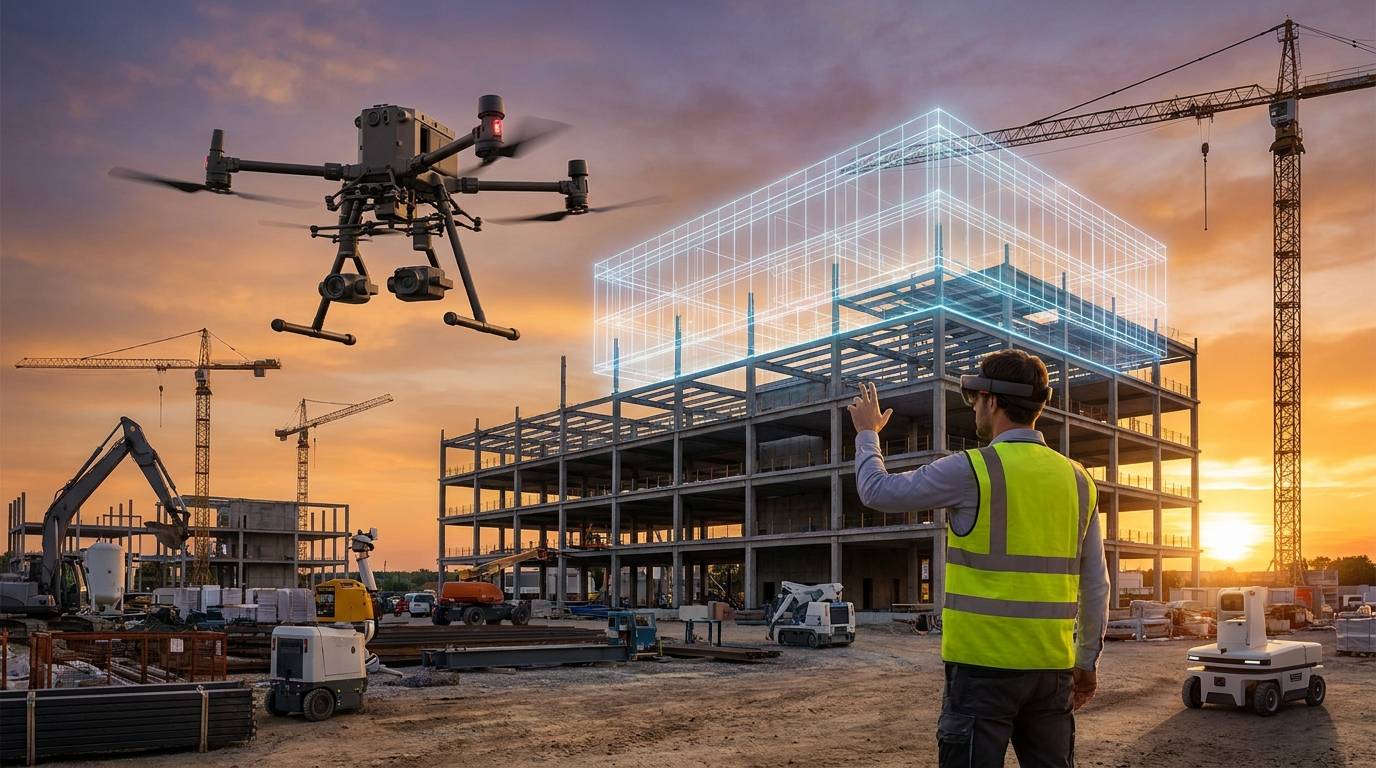
The global construction industry is at a historic turning point. Driven by an urgent need for efficiency and a global shortage of hundreds of thousands of workers, construction companies are rapidly abandoning traditional methods. Today, building smarter is no longer a luxury—it is an operational survival requirement.
If you want to stay ahead of the curve, here are the top 10 construction technology trends shaping the industry in 2026.
1. Digital Twins as the New Industry Standard
While Building Information Modeling (BIM) has long been the baseline for project design, 2026 marks the year digital twins become standard across major projects. Unlike a static 3D model, a digital twin is a live, data-driven replica of a building. Fed by real-time IoT sensors, digital twins allow project managers to track structural health, optimize energy use, and predict maintenance issues before they happen.

2. AI-Driven Estimating and Project Controls
Artificial Intelligence is the operational brain behind modern construction sites. Instead of replacing human project managers, AI is being deployed to eliminate guesswork in estimating, scheduling, and risk analysis. AI algorithms rapidly analyze historical data to predict exactly how much material a project needs, preventing costly over-ordering and lowering procurement friction.
3. Construction Robotics Tackling Labor Shortages
With structural labor deficits impacting major markets globally, robotics have stepped out of the lab and straight onto the job site. In 2026, we see widespread deployment of autonomous bricklaying robots, self-driving excavators for heavy earthworks, and robotic systems that pre-assemble panels in controlled offsite factories.
4. Drone-Based Site Intelligence
Drones are now standard field equipment. Equipped with high-definition cameras, LiDAR, and specialized sensors, drones map terrains in minutes instead of days. This real-time aerial data feeds directly into project management platforms, giving teams a continuous, millimeter-accurate look at daily progress and safety bottlenecks.

5. Advanced Green and Low-Carbon Materials
Sustainability is a massive driver of modern search interest. To meet strict environmental rules, contractors are adopting smart, eco-friendly materials. This includes low-carbon concrete mixes, self-healing smart composites, high-efficiency insulation, and carbon-capture building materials that actively pull greenhouse gases out of the atmosphere.
6. Offsite and Modular Construction
Building components inside a factory and assembling them on-site is a massive trend for 2026. Modular construction drastically reduces on-site labor demands and cuts weather-related project delays. It is especially growing in dense urban zones where space, noise restrictions, and tight schedules limit traditional building options.
7. IoT Wearables and Smart Safety Tech
Safety management has gone completely digital. Modern site workers are equipped with IoT-enabled wearable devices—such as smart boots and high-tech vests—that track movement, fatigue, and environmental exposure. Smart site sensors also monitor ambient noise, dust levels, and hazardous chemical exposure in real time to keep teams safe.
8. 3D Printing at Scale
No longer a novelty gimmick, 3D printing is providing real structural solutions. Large-scale 3D concrete printers are being used to build complex architectural features, affordable housing units, and specialized structural components. This method reduces material waste down to near zero and shortens construction timelines significantly.
9. AR and VR for Risk-Free Training
Augmented Reality (AR) and Virtual Reality (VR) are transforming safety training and client coordination. Contractors use VR headsets to train heavy machinery operators safely before they ever step into a real cabin. Additionally, AR overlays allow crews to look through walls on-site to view hidden plumbing, electrical, and structural lines before drilling.
10. Cloud Collaboration and Mobile Field Management
The era of carrying massive rolls of paper blueprints is over. Cloud-based collaboration software acts as a "single source of truth," ensuring that field engineers, architects, and owners are looking at the exact same data in real time. Change orders, safety forms, and daily progress logs are now managed entirely through mobile field apps.
Why This Matters For Your Next Project
Emopting these digital construction trends is no longer about chasing a tech fad—it is about protecting your bottom line. Investing in digital infrastructure minimizes expensive reworks, addresses chronic labor constraints, and helps projects stay on schedule and under budget.
What construction technologies are you deploying on your project sites this year? Let us know in the comments below!
No comments yet
Be the first to share your thoughts!