


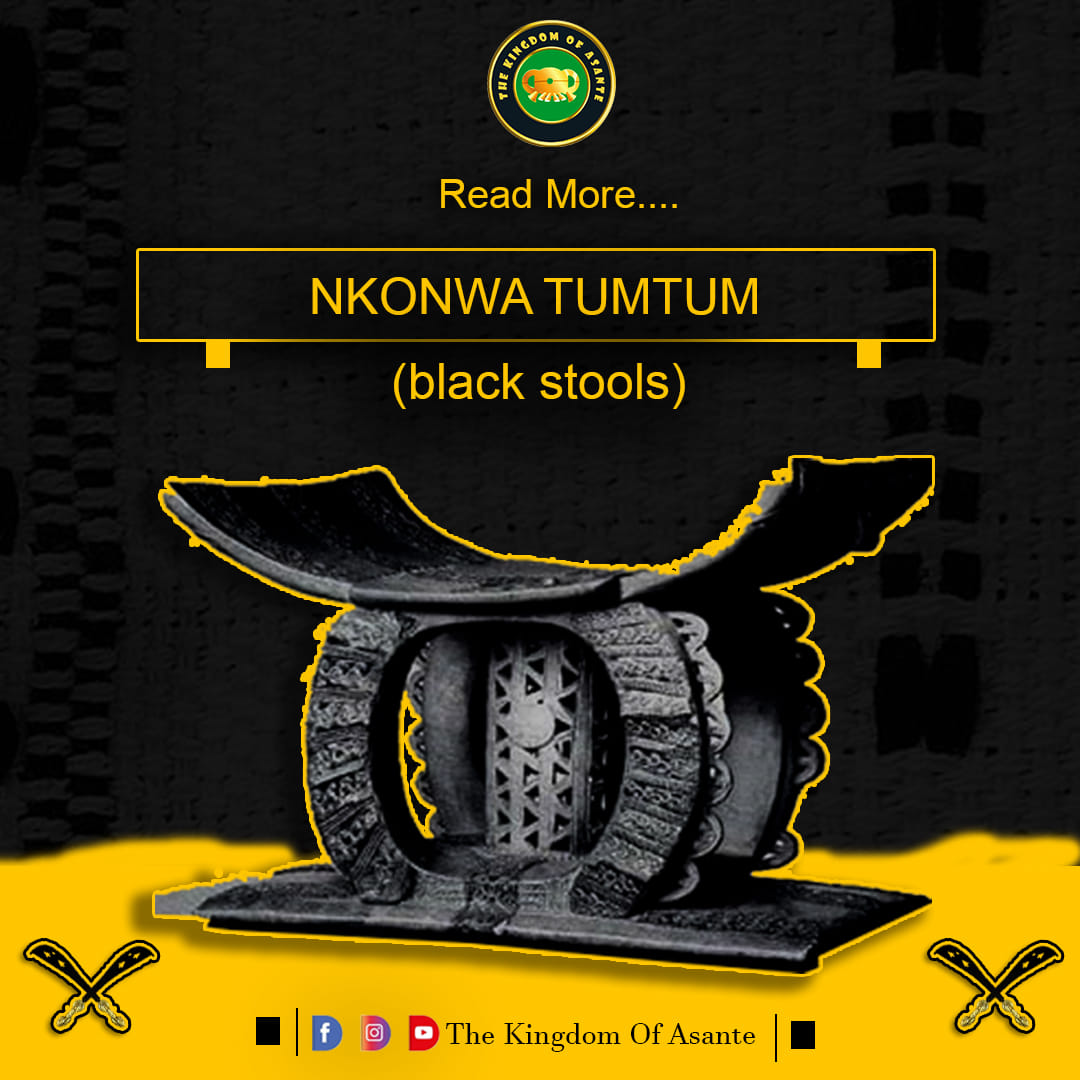
Stools are carved from “sese†or odum tree and among Asante and other Akan peoples. Stools play an important role in each person’s life. When children learn to crawl, they receive stools as their first gift from their father. For young women, puberty rites entail sitting on their stools. A husband presents his wife with a stool when they marry. When an extraordinary leader passes away, his or her “sesedwa†(stool) which the decreased used for bathing is blackened and placed in the “nkonnwafieso†or ancestral stool house. Most at times, this process is reserved for chiefs and Queen mothers but some heads of lineages like the Abusuapanin or ɔbaapanin and Traditional priests and priestess have their stools blackened too. In the olden days’ human sacrifice was involved. Following prayers and libation, blood drawn from the neck of an important member of the lineage was mixed with other ingredients like soot, egg yolk and spider web were smeared on the stool.

The original stool of the particular matriline is named after the man whose soul is sealed inside. During rituals when the stool is carried out and the carrier generally goes into a state of trance. Formally during the celebration of Addae and other festivals, slaves or war captives were sacrifice in the stool room of the chief’s palace and victims were kept in a special place belonging to the chief. Human sacrifice ceased towards the end of 19th century because of British ordinances and today castrated ram are used. Recent stools that have created with sheep blood are not considered by many people to be sufficiently strong. Today blackening process involves coating the stool in a mixture of soot, spider web ,egg yolk and sometimes gunpowder which is then layered over time with sacrificial offerings such as sheep’s blood Peter Sarpong (1971) as cited in The Sacred of stools in Akan suggested three (3) key reasons why ancestral stools are blackened: to keep them from becoming ugly or visually distressing when the receive sacrifices, to represent the relationship between the living and the decreased ancestors through colour symbolism( in certain contexts, black is a sign of mourning, in others, it is frightening, which calls for respect and veneration, both of which are appropriate for ancestral stools), and finally, or durability which is the blackening process acts as a kind of preservation agent that helps to keep the stools in good form for successive generations.
The ingredients used to blacken stools are the same as those used to consecrate stools destined for the court of Asantehene. The parallel use of materials in blackening and consecrating suggests that they have significance beyond reasons and one possibility of the spider web as an ingredient and decorative motif in some way references Ananse the trickster spider, who is a symbol of wisdom, creativity, and the complexities of life all that pertains to leadership in both the earthly and ancestral realms. Eggs are used frequently in Asante ceremonies that involve safeguarding and fertility, such as the female puberty rite, bragorÉ”. Gun powder is associated with men who went to war with members of their group of patrifiliation. Soot is also covered for preservation. Since protection and propagation of the lineage are the key concerns of ancestors, in the inclusion of egg yolk may have relationship with their capacities.
Black stool is believed to be inhabited by the spirit or sumsum of the head of the lineage for whom it was consecrated, and therefore to possess the magical quality of being able to protect the living members of the lineage. Duties that must be performed in relationship to ancestral stools include making offerings of sheep, chickens and drinks to them on a regular basis. Because ancestors are understood to be capable of participating actively in the affairs of the living, they must be kept happy and satiated. During sacred festivals such Akwasidae and Wukudae which is held at six (6) week intervals on Sundays and Wednesdays are designated specifically for the celebrating the ancestors. Each lineage has a specific area for the housing of the blackened stools of the ancestors. The black stools are not allowed to be placed directly on the ground and these black stools are kept in the Nkonnwafieso or stool house to prevent public view and possible pollution. The door way to the stool house is covered with a precious cloth called “nsaa†and individual permitted to enter it are few. They enter it on festival days and other sacred days. In some families, the Queen mothers’ stools are kept separate from chief’s stools whiles in others they are housed in the same room. It is a taboo for a menstruating woman to enter the nkonnwafieso or the stool house and some queen mothers who are pre-menopausal have Akyeame (Linguists) perform their duties in the stool house, in addition to their own, on their behalf. Generally, it is the linguist who is responsible for pouring libations in honour of the ancestors. Though these responsibilities may be shared with the Krontihene and others.
A black stool is multifaceted symbol that represents the identity of a group of people as well as being a recognized valuable and a focal point for religious practices. The belief in the power of Nananom nsamanfoÉ”(Ancestors) which is embodied in the black stool continues despite the increase influence of Christianity in our society; the black stools are a set of explanations that complement those Christian doctrines like sainthood in Catholic and Orthodox churches but reject deities such as Suman and Abossom. They have difficulty rejecting the ancestors who directly linked to history, chieftaincy and black stools may be said to actually bring the past to the present.
Credit: Kofi Frimpong ( The Kingdom Of Asante )
Flyer Designed By: EO Ntiamoah ( The Kingdom Of Asante )