


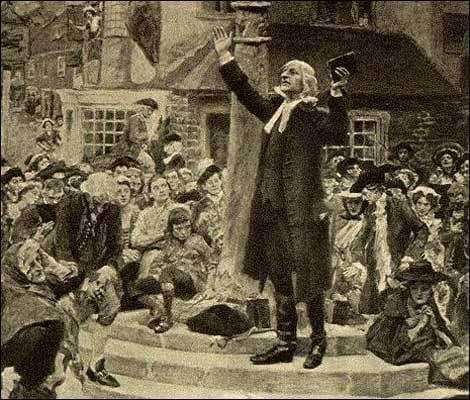
When John Wesley and his brother came over to the United States as missionaries to the Indians in Georgia, they weren’t successful in their attempt to convert the
Indians. While traveling back to their home by boat, the Wesleys learned some deeper truths about God from a group that was present on the boat.
When John Wesley returned to England, he was preaching some of these truths, and the church leaders put him out of the church right in the middle of his sermon. Wesley wanted to finish that sermon, so he stood on his father’s tombstone in the churchyard and
preached. In England in those days, the dead were buried in the churchyards.
As Wesley stood on his father’s tombstone outside and preached, some of the people came outside and listened.
Surprised, Wesley reportedly said, “To my astonishment,God met us out there. Up till then we didn’t know God would meet us anywhere except in that building. But God
met us out there in the open air.”
Later, John Wesley and John Whitfield became the first, what we call, “field preachers.” They hadn’t known God would meet them anywhere else but inside the church building. They had attached great significance to the building. But they learned that one can sit and listen in reverence to a service outside in a tent or in an open-air
crusade just as well as he can in a church building.
Certainly, people should be taught to be reverent to God while a service is going on or while the Spirit of God is manifesting Himself to minister to people. But if we are not careful, we can attach too much significance to natural places and things and miss the Person of Jesus, whom we are actually worshipping. And we can miss the
reality of our own bodies being the temple of the Holy Spirit.