


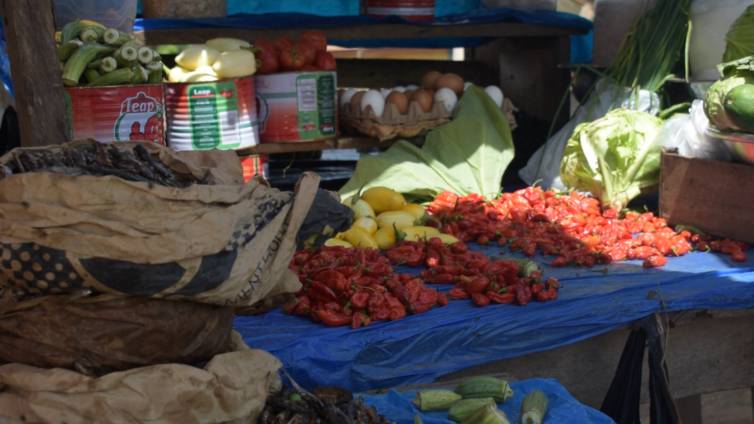
The Ghanaian Peasant Farmers' Association has predicted that food prices will continue to rise.
Dr Charles Nyaaba, the Association's Head of Programs and Advocacy, noted that this is owing to the high cost of production.
"If you look at the prices of food in subsequent days, it's going to be very difficult because even if you hold all the factors constant, because the cost of production is very high, so even if there's a bumper harvest, it doesn't mean the farmer will sell his produce at lower prices," he said on Joy FM's Super Morning Show on Wednesday. Because if he does that, he won't be able to cover the cost of producing an acre." Mr. Nyaaba said that farmers were producing at a cost of GH1,600 the previous year, but due to the high cost of production, the budget has increased by more than 200 percent this year.
"When we made our agricultural budget last year, it cost roughly GH1,600 cedis to produce one acre of maize." "We are earning roughly GH3,700 cedis for the same acre when we include in the current increase in input prices," he said.
His remark comes in the aftermath of increased food costs, as well as increases in the cost of petrol and other commodities. Mr. Nyaaba stated that fertiliser is one aspect that has greatly increased the cost of manufacturing. "Even with the government subsidies, the cost of fertilizer alone has increased by almost 200 percent, as has the cost of tractor services and agrochemicals." So, regardless of the yield per acre, if a farmer needs to spend that much on one acre, he or she will not feel happy selling at a lower price," he added.
As a result, he has urged the government to spend more in agriculture.
"The only option for farmers to stay in business is for the government to shoulder the financial burden. When you travel to other nations, you will see that they cut budgets from other sectors to invest in agriculture, but in 2022, we lowered the agriculture budget by around 28% instead.
He also decried the inaccessibility of government-subsidized fertilizer to farmers owing to outstanding payments owed to fertilizer providers by the government, warning of catastrophic implications if the issue is not resolved.
"At the moment, the fertilizer companies are unwilling to supply the subsidized fertilizer because the government owes them GH86 million for what they supplied in 2020, and the government owes them GH260 million cedis for what they supplied in 2021, and these monies haven't been paid yet," says one source.
"So it is the government's responsibility to settle them so that they may manufacture the fertiliser," he said, "but we have no indication as to when the government would settle them."