


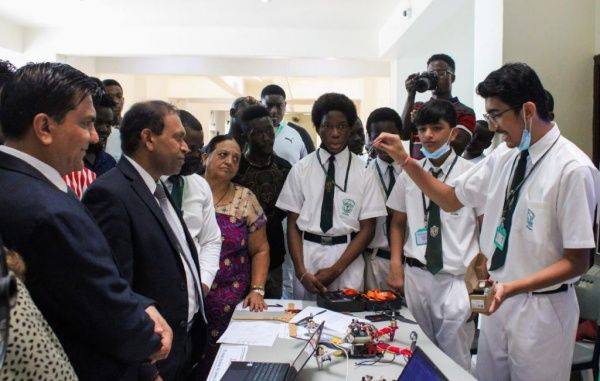
Sugandh Rajaram, the Indian High Commissioner, stated that his nation will continue to work with Ghana in several sectors, including innovation and technology, in order to ensure both countries' long-term growth and development.
He said this in an interview during a science fair at DPS International in Tema, where pupils displayed future-oriented solutions.
"Our partnership continues to prioritize innovation and expertise. "We're collaborating with the Ghanaian government and other stakeholders to guarantee that new development, capacity building, and ideas are implemented," he said.
Students displayed innovations in the areas of security, health, agriculture, energy, and sustainable cities, to name a few, at the science fair, which was themed 'Sustainable Solutions for a Sustainable Future.'
Sugandh Rajaram was blown away by the creative thinking ideas on the show.
Educational institutions, he claims, are a vital element of both nations' growth, particularly in terms of innovation, research, startups, and other future-oriented activities.
"I believe it would be a stimulant in the expansion of the collaboration if we gain the support of educational institutions like DPS International in this endeavor," he said.
He praised the students and school officials and urged them to continue to make the most of the opportunities presented to them.
A drone designed to assist firemen was one of the exhibition's main attractions.
In comparison to a standard drone with a 10-inch propeller, the project (JARVIS) produced a drone with 20,200 revolutions per minute (rpm) motors that provide 4kg of torque.
The drone includes functions such as facial recognition and identification, and it will assist firemen in rescuing trapped people by flying into the fire and electronically transmitting information to the firefighters within a minute.
This concept aims to reduce the number of times firemen enter a building without knowing how many people are inside or where they are.
The innovators are Shriman Jha, Raj Thakwani, Ernest Mintah, Chris Amankwah, Semekor Pi-Bansa, and Barima Yaw Ofori-Boateng Kyeremanteng.
Some of the students created power from biodegradable trash after deciding on cow dung, as the globe continues to look for better sources of energy.
According to Varunikha Anandan Sangeetha, a member of this group, the cow dunk was able to withstand two weeks of fermentation.
The steam from the pressure cooker was powerful enough to move turbines that generated energy, allowing them to charge a rechargeable battery to power an automobile.
Another group, led by Nana Akosua Birago Sefa, investigated an automated lighting system that turns off during the day owing to inadequate electricity but turns on at night when the voltage is sufficient to light a lamp
This is believed to be distinct from solar power in that it does not require batteries to store energy.
Three students, Kezia Ewuradjoa Nkrumah, Nana Kwame Kyeretwieh Osei Tutu, and George Ernest Gambrah, invented a dialyzer to aid the country deal with renal failure.
Two tubes are inserted into the body, with the blood flowing into the dialyzer to be filtered. The urea, excess salt, and excess water are subsequently removed, and the filtered blood is returned to the body to be circulated.
Apart from other methods, the team recommends eating a nutritious diet, drinking enough of water, exercising, eating fewer fatty and sugary foods, lowering salt consumption, and relaxing to lessen the risk of renal failure.
This therapy might cost up to $72,000 per year, or $500 each 6-hour session.
Following his observation of these innovations, Samuel Okoe Amanquah, Municipal Chief Executive of Kpone-Katamanso, stated that similar fairs may be reproduced across the public and would have a big influence.