


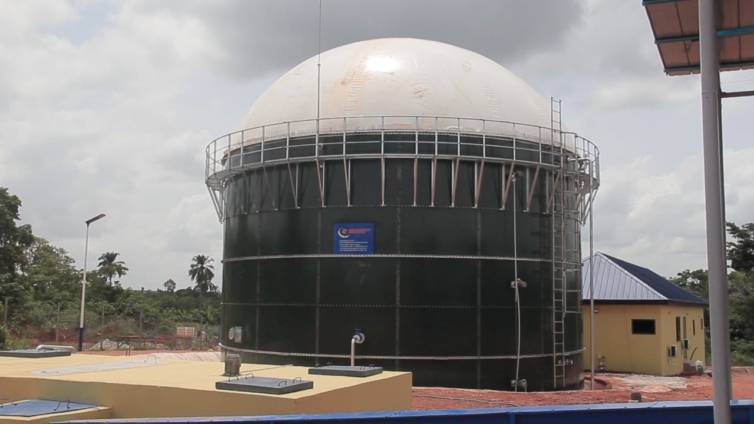
Gyankobaa in the Ashanti Region's Atwima Nwabiagya Municipality has commissioned a hybrid waste-to-energy power plant.
The 'Hybrid-PV-Biogas-Pyrolysis-Plant,' a 400-kilowatt plant, can transform 12 tons of garbage into bio-fertilizer and electricity every day.
The German government is funding the facility through the Federal Ministry of Education and Research.
The €6.2 million initiative is considered as one of the answers to Ghana's waste management and power generating problems, as well as decreasing pollution and climate change-related health risks.
The facility will also aid in the reduction of trash in Kumasi, the diversification of energy sources and supplies, and the creation of jobs for over a thousand people in the region. The project was developed in partnership with the Ministry of Environment, Science, Technology, and Innovation and is headed by the University of Rostock at Germany's West Africa Science Centre in Climate Change and Adapted Land (WASCAL).
Dr. Kwaku Afriyie, Minister of Environment, Science, Technology and Innovation, spoke on behalf of President Akufo-Addo, saying that the government will continue to engage stakeholders to develop creative and sustainable initiatives to assist address the country's various difficulties.
He explained that the hybrid initiative comes at a critical moment for big cities such Ghana Accra and Kumasi, which are grappling with how to effectively deal with trash.
He feels the effort will aid in resolving the waste management issues that Metropolitan, Municipal, and District governments face.
At Gyankobaa, the government commissions a €6.2 million waste-to-energy conversion facility.
Dr. Kwaku Afriyie went on to say that the energy sector's debt, along with the cost of power generation, has a significant impact on the economy, and that it is thus vital to accept the waste-to-electricity plant.
He said that the facility will also create bio fertilizers, which will improve agriculture by reducing the use of mineral fertilizers, enhancing soil structure, and contributing to Ghana's climate change mitigation strategy.
Dr. Stefan Kaufmann, a representative of the Federal Ministry of Education and Research, praised the government and other partners for their steadfast support of the initiative.
He said that launching the project was important to solve long-standing issues such as garbage accumulation and a shortage of electricity in many sections of the country.
At Gyankobaa, the government commissions a €6.2 million waste-to-energy conversion facility.
According to Dr. Kaufmann, the plant will be beneficial in addressing the myriad health and environmental issues that individuals confront.
He claims that, in addition to creating jobs, the factory would help Ghanaian farmers produce more bio-fertilizers.
At Gyankobaa, the government commissions a €6.2 million waste-to-energy conversion facility.
Nana Obofuo Atwimakwaa Boakye-Darkwah II, the Chief of Gyankobaa, thanked the Ghanaian and German governments for constructing the waste management project.
He urged the President to finish the road-building in the area. At Gyankobaa, the government commissions a €6.2 million waste-to-energy conversion facility.
Meanwhile, if the Gyankobaa pilot plant proves to be successful, plans are in the works to create 10 more of these facilities in different locations over the next 20 years.