


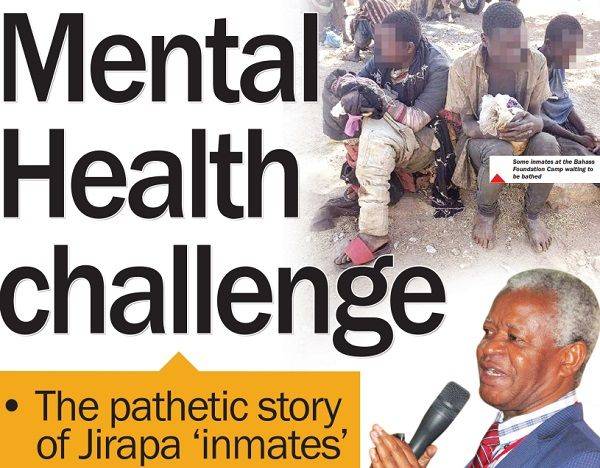
It appeared to be a refugee camp. At Zongo, a neighborhood of Jirapa in the Upper West Region, a dusty courtyard is full with people sprawled out on mats alongside a big church that functions as a hostel outside prayer hours.
The majority of these individuals have spent months, if not years, in the Bahass Foundation Camp, where they are cared for after being abandoned by their family.
"Most mentally sick people in our culture are thought to be possessed by evil spirits. "Everyone is frightened of them," said Charles Zinyeni, the Camp's founder.
Mr Zinyeni grew raised in the Wa West District's Wechiau and migrated to Jirapa in 2001. Mr Zinyeni had his first firsthand interaction with one of the homeless "madmen" in 2003 while going along the main street.
"There was a mentally sick individual going through a garbage bin for food," he explained. Mr Zinyeni said he was driven to look at the man as a rational person by a religious obligation.
"From then on, I would travel through Jirapa's streets every day to observe where they slept." Later, I began to meet them and approached them, and it was then that I realized they were humans who, like everyone else, wanted to be loved," he explained.
Those at the Jirapa Bahass Foundation Camp are just a small sample of the country's mental health sufferers, who are seen as public nuisances at best and as evil spirits at worst.
Psychiatric facilities
A group of dedicated volunteers from the Ghana National Association of the Deaf (GNAD) conducted a study to assess the knowledge of and barriers to mental health services among people with hearing loss in a country of over 30 million people with only three fully functioning public psychiatric hospitals in the southern part of the country - the Accra Psychiatric Hospital and Pantang Hospital both in the Greater Accra Region and the Ankaful Psychiatric Hospital in the Central Region.
Their goal is to gather evidence-based data in order to assist one of the country's most vulnerable populations: hearing-impaired persons.
The outcomes of the study revealed that, despite national attempts to increase mental health access, hearing impaired people's mental health services had not been encouraging.
The study focused on the hearing impaired since they cannot interact effectively with healthcare providers, discouraging the grouping of mental health problems of persons with impairments in the country.