


The Ghana Agricultural Sector Investment Programme (GASIP) is currently 86 percent implemented.
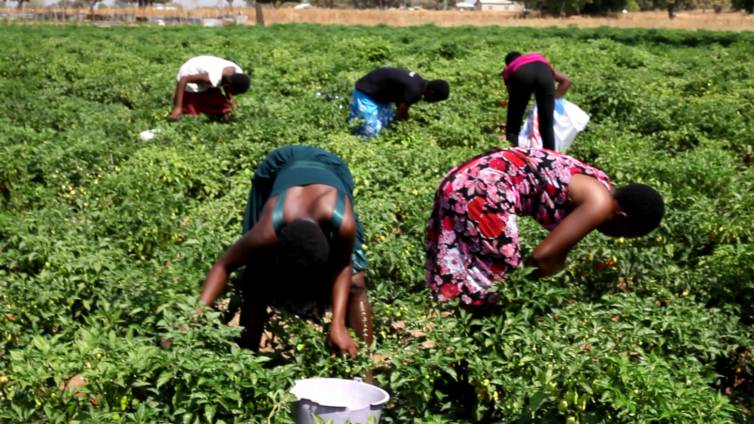
Smallholder farmers were helped, and common values and opportunities were fostered throughout the rice, maize, soya, and vegetable value chains.
GASIP also invested in capacity building and training of smallholder farmers in sound agricultural practices and climate change resilient technologies, according to Klutse Kudomor, the National Programme Coordinator.
The GASIP design leverages private sector resources and expertise to make smallholder farmers more competitive by increasing their efficiency and resilience to climate change by providing appropriate technology, rural infrastructure, and gender transformation, including equal participation of women and youth.
Mr. Kudomor delivered the keynote address at a workshop titled "Building Champions in Agribusiness Value Chains for Climate Change Resilience."
The four-day training in the Ashanti Region's Nkawie will equip them to become ambassadors, engaging and sensitizing stakeholders, particularly farmers, on climate change and environmental sustainability in their organizations, communities, schools, and faith-based organizations.
Klutse Kudomor reports that GASIP deployment is presently at 86%.
The Ghana Agricultural Sector Investment Program (GASIP) is being implemented by the Ministry of Food and Agriculture, and is supported by an IFAD loan of USD 36 million and a USD 10 million Adaptation for Smallholder Agriculture Program (ASAP) grant.
The Adaptation for Smallholder Agriculture Programme is IFAD's main climate-channeling effort. "GASIP has had some extraordinary results over the previous two years that ought to be highlighted," Mr. Kudomor remarked.
GASIP has made significant investments in rural infrastructure, including providing access roads to connect farmers to markets, solar-powered boreholes for dry-season vegetable production, and weather stations to provide accurate and timely weather information, according to the National Program Coordinator.
Klutse Kudomor reports that GASIP deployment is presently at 86%.
According to him, the initiative has built 600 hectares of rice-growing irrigated land and given 628 smallholder farmer organizations with tractors, power tillers, and handheld rice harvesters.
According to the National Programme Coordinator, GASIP has made significant investments in rural infrastructure, including providing access roads to connect farmers to markets, solar-powered boreholes for dry-season vegetable production, and weather stations to provide accurate and timely weather data.
According to him, the initiative has constructed 600 hectares of rice-growing irrigated land and given tractors, power tillers, and handheld rice harvesters to 628 smallholder farmer organizations.
GASIP has also provided production inputs, training in sound agricultural practices, climate change resistance, food safety and food quality, business operational excellence, and food processing to approximately 150,000 smallholder farmers."
GASIP is also working with agribusinesses to provide smallholder farmers with market access by enrolling them in the Ghana Commodity Exchange's market pricing information.
"When the COVID-19 pandemic broke out in 2020, IFAD launched a new project under GASIP called Emergency Support to Rural Livelihoods and Food Systems Exposed to COVID-19 (ESRF)." GASIP has delivered better seeds and fertilizers to over 20,000 smallholder farmers across the country through the ESRF."
According to him, the Gender Ministry and the World Food Programme have received a total of US$1.85 million for severely vulnerable farmers, including individuals with disabilities, from the country's nine poorest districts.
GASIP's mission is to eradicate poverty in rural Ghana by increasing the profitability of agribusinesses and smallholder farmers, as well as their ability to withstand climate change.
GASIP's implementation status was only 12 percent in the first four years (between 2015 and 2019), prompting IFAD to terminate the initiative owing to non-performance.
Mr. Kudomor claims that performance improved from 12 percent to 76 percent in less than a year after the present management took over in 2019.
As a consequence, GASIP's implementation status was changed from "non-performing" to "performing" by the IFAD.