


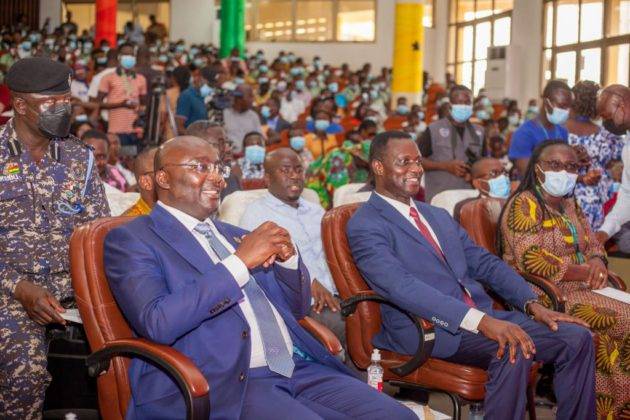
Students in postsecondary institutions will no longer require a guarantor in order to get loans from the Students Loan Trust Fund (SLTF).
A student merely requires an acceptance letter and a Ghana Card to get a loan under this arrangement.
Last Wednesday, Vice President Dr Mahamudu Bawumia announced the 'No Guarantor Students Loan Policy' at the Kwame Nkrumah University of Science and Technology (KNUST).
Vice-Chancellors of public universities, a Deputy Minister of Education, Rev. Ntim Fordjour; the Ashanti Regional Minister, Simon Osei-Mensah; and other metropolitan, municipal, and district chief executives were among those in attendance at the occasion.
Some students from the region's higher and secondary schools were also there.
Accessible
He said the policy was aimed at making tertiary education accessible to all Ghanaians during the unveiling in Kumasi.
He said that it was also in fulfillment of a platform pledge made by the ruling New Patriotic Party (NPP) during the 2020 election to remove financial barriers to postsecondary study.
Digitalisation
One of the benefits of the government's digitalization process, according to Dr Bawumia, is that students may apply for loans without having to provide a guarantor.
"One of the advantages we gain as a country from emphasizing digitalization is this." When we stated we were going to construct the fourth industrial revolution, we meant it. Many people didn't get us when we talked about a data-driven economy with digitalisation as the anchor," he remarked.
The existing international order, according to the Vice President, requires that every economy be digitalized, and that "if you don't digitalize, you will be left behind."
"Forget about it."
Traceability
"The Ghana Card offers us all the data we need about the students to make a choice on their loan," he said, adding, "and we are quite certain that card provides us all the information we would need to recover the debt."
Dr. Bawumia stated that an echo-system was being developed around the Ghana Card, which would have all of the information required for a passport, including a digital address."From July, we will connect all your bank accounts to your Ghana Card number," he stated. "The Ghana Card number is now your National Health Insurance Scheme number, your Social Security and National Insurance Trust (SSNIT) number, and your Tax Identifi cation Number (TIN)."
Policy is required.
The adoption of the Free Senior High School (SHS) program, according to Dr Bawumia, has opened the floodgates for more individuals to enter postsecondary education.
However, he noted that some outstanding kids were unable to pursue postsecondary education owing to a lack of cash, and that for those who were able to do so, the standards for student loans were so onerous.
because some people were not eligible for it. Development
Dr Yaw Osei Adutwum, the Minister of Education, stated that there is a link between tertiary education enrollment and country growth.
According to research, most developing nations have a high university education enrolment, whereas impoverished countries have a lower tertiary education enrolment.
Despite the fact that the country's tertiary education enrolment was more than double that of the United States, he said that
There was still work to be done on the sub-regional average.
According to him, higher education in Sub-Saharan Africa is at 9%, but it is at 20% in Ghana.
According to him, the "no guarantor" policy will result in more students enrolling in higher institutions to gain skills and create human capacity for the country's growth.
Barrier
Nana Kwaku Agyei Yeboah, the Executive Director of the SLTF, confessed that acquiring guarantors to help students acquire a student loan was a major difficulty for most students.
As a result, he claims that only a few suitable students were able to obtain the funds they needed to continue their school.
He said that the new policy will make it easier for more students to get financial aid for their postsecondary education.
It would also put extra on on the trust to find other sources of funding for its operations.
Interest
Dennis Appiah Larbi-Ampofo, President of the National Union of Ghana Students (NUGS), thanked the government for the initiative.
He was concerned, however, because the loans were accruing interest while children were still in school, and he demanded that the error be addressed.
He proposed that the loans begin charging interest once the pupils had graduated from high school.