


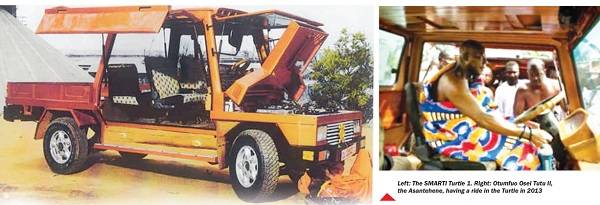
The plan to build cars at Kumasi's Suame Magazine is still alive.
The initiative's primary architect, Nyaaba Aweeba Azongo, said that the project's plan was still in tact and that all that was required to restart it was the cooperation of the government.
The Suame Magazine Industrial Development Organization (SMIDO), a non-governmental organisation that aims to turn the neighbourhood into a technologically cutting-edge industrial estate, and its artisans launched the automobile manufacturing project in 2013.
"To determine the cost of converting the Suame Magazine into a contemporary industrial estate, a comprehensive industrial survey was required.
"The key to commencing the entire process was the acquisition of land, which was then followed by technical survey, technical design and costing, and the mobilisation of finances for construction. Mr. Azongo, the project consultant, told the Daily Graphic that we were unable to obtain the property.
energy play
Additionally, he said that the project was hampered by power struggles inside SMIDO.
"Power struggles occurred inside the organisation. The initiative failed due to politics and a lack of support from the administration, according to Mr. Azongo.
In light of this, he urged the government to back proposals to resurrect the project.
George Asamoah Amankwa, a former president of SMIDO, too bemoaned how the initiative failed. He told the Daily Graphic, "I don't want to express a lot of stuff.
Turtle SMARTI 1
A prototype vehicle known as "SMARTI Turtle 1" was constructed by 30 mechanics at Suame Magazine over the course of three months in 2013 with the help of the Kwame Nkrumah University of Science and Technology and the Netherlands' Aardschap Foundation, a non-profit organisation that specialises in action-research in settings where people organise themselves (KNUST).
The SMIDO's great plan to transform the industrial enclave's outside into a manufacturing hub included the construction of the vehicle.
Suame Magazine Automatics Technical Institute, often known as SMATI, is a SMIDO-initiated institutional engineering training idea for the artisanal engineering sector.
After two prior car manufacturing ventures in the nation failed, the Turtle 1 was produced. In the 1950s, the nation began producing its own automobiles (the Patuo series), and in the 1970s, the Boafo concept car was created. But they all failed to take off.
Attraction
The car drew a lot of interest from Ghanaians, especially when Asantehene Otumfuo Osei Tutu II launched it during a visit to Suame Magazine in 2013.
Following many trials in Ghana, the vehicle undertook a full-day test at the Dutch Vehicle Registration Authority (RDWtest )'s facility in Lelystad, the Netherlands, becoming the first African vehicle to ever be examined there in June 2013.
The vehicle also went on a promotional tour of Europe, appearing in various television programmes in Germany and the Netherlands and on display at a number of events. Report on testing
Roman van Dijk, the Technical Inspector at the Test Center, emphasised in the testing report key strengths of the Turtle 1, such as the expertly crafted bodywork and superior structure.
However, he also expressed some critical statements about technological expertise and security issues that would help direct the Turtle's future growth.
The Turtle 1 "displayed the qualities, energy and prospects of Suame Magazine as a site for automobile manufacture and the potentials of an African car," according to Aardschap Foundation.
"The Turtle 1 is genuinely African, not European, American, or Asian. Heavy-duty jobs may be accomplished by the Turtle. It is entirely mechanical and can be fixed using basic tools, according to the Foundation.
The statement said, "Since the construction and top are handcrafted, it is simple to rebuild the automobile to offer it a different use, such as a towing truck, lorry, or neighbourhood taxi. Being a turtle, it might not be the world's quickest vehicle, but it can live a very long time. Above all, it is durable, reliable, and practical. So the Turtle moves slowly but steadily.
Aardschap contacted the Automotive Institute of the University of Applied Sciences (Arnhem and Nijmegen) to see if the Turtle might be enhanced and developed further in light of the lessons learned during the construction of the Turtle 1.
Re-branding
The consultant for SMIDO said in an interview with the Daily Graphic: "The Danish International Development Agency (DANIDA) stepped in.