


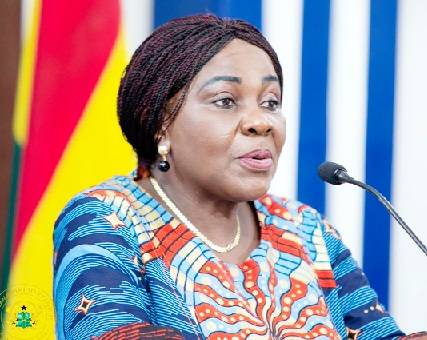
According to Cecilia Abena Dapaah, Minister of Sanitation and Water Resources, the government has continued to battle against "galamsey," or illicit mining, which worsens the turbidity and coloration of the nation's water bodies.
She noted that illicit mining, which shouldn't be supported, has a negative impact on around 22% of the nation's surface water resources with toxins and pollutants like mercury, among others.
She claimed that the fight against galamsey was a national one that needed to be fought in order to defend water bodies that provide the nation with clean drinking water.
Last Tuesday, in answer to a query from the New Patriotic Party, Mrs. Dapaah made this statement on the floor of Parliament. The extent to which illicit mining was causing the country's water bodies to deteriorate was something Ms. Bartels sought to learn from the minister of sanitation and water resources.
In response to the inquiry, Mrs. Dapaah explained that turbidity was a measurement of how much the presence of suspended particles reduced the water's clarity.
She stated that a turbidity value of five Nephelometric Turbidity Units (NTU) was acceptable for drinking water, while levels of 80 to 150 NTU were suitable for other water usage.
"Mr. Speaker, at the end of February 2022, the Southwestern River System, the country's primary illegal mining region, had an average turbidity of 1,313; the Volta River System had a turbidity of 40; and the Coastal River System had a turbidity of 40.
Resulting from galamsey
According to Mrs. Dapaah, the Volta River System drains 70% of the nation, while the Southwestern System takes in 22% and the Coastal System takes in 8%.
Therefore, illicit mining is widespread and has a negative impact on around 22% of our surface water resources, according to the speaker.
Pollution and sanitation tax
In response to another query from Manhyia North MP Akwasi Konadu regarding the amount of funds her ministry had received from the Sanitation and Pollution Levy and how those funds were being used to address sanitation issues in the country, Mrs. Dapaah stated that her ministry had not yet received notification of the total funds accrued from the levy.She said that the Sanitation and Pollution Levy (SPL) was to be received by the Ministry of Finance and that her ministry had not been informed of the entire amount accumulated and the procedures for release.
However, Mrs. Dapaah pointed out that her ministry has put up proposals to use the SPL funding all around the nation.
She stated that the money will go toward infrastructure and services for solid waste management, liquid waste management, public awareness campaigns, and law enforcement, monitoring, and assessment.