


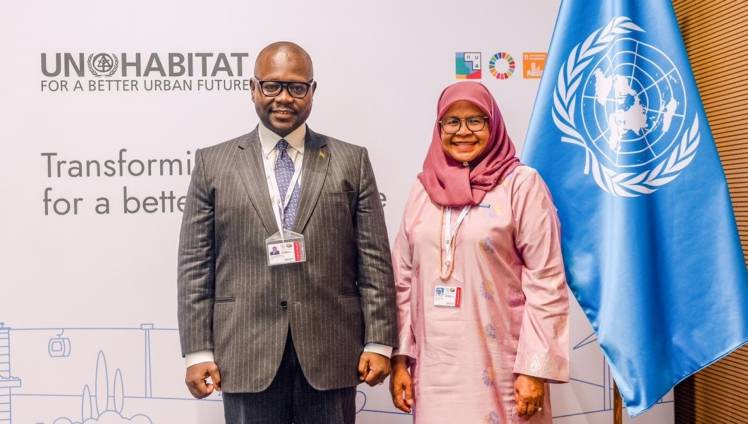
UN-Habitat, the human settlements programme of the United Nations, has reaffirmed its commitment to working with the Ghanaian government to achieve sustainable urbanisation and enhance climate change resilience.
This comes after a discussion that took place on Monday, June 27, 2022 during the current World Urban Forum (WUF11) in Katowice, Poland, between Francis Asenso-Boakye, Ghana's Minister for Housing, and Maimunah Mohd Sharif, Executive Director of UN-Habitat.
As part of their interaction, the two officials looked into potential partnerships aimed at solving regional and international problems including climate change adaptation and the effects of growing urbanisation on communities, cities, and economies.
Additionally, they discussed the creation of sustainable human settlements to help achieve Sustainable Development Goal 11, which calls for inclusive, secure, and resilient cities.
In her remarks, Maimunah Mohd Sharif, the head of UN-Habitat, commended Ghana for being one of the select few nations to have produced and filed their report on the New Urban Agenda's implementation.
Since it is connected to the supply of fundamental and vital services like water, sanitation, and public health, she noted the necessity of giving affordable housing in cities first priority.
According to her, one of the best ways to guarantee that cities are designed and developed in a way that has a positive influence on a greater part of society is to provide affordable housing.
She emphasised that Ghana must take climate change adaptation seriously and praised efforts by the country's housing minister to establish a National Urban Forum.
a forum for involving local stakeholders at different levels to look on ways to improve cities' resilience.
It provides a forum for high-level discussion on the potential of national urban policies to address issues in the fields of environment, housing, mobility, spatial planning, innovation, and technology. It also deepens understanding of the relationship between national urban policies and current crises.
Mr. Asenso-Boakye reiterated in his response the necessity of prioritising affordable housing, not only to address housing shortages for sizable segments of the population in cities, but also to ensure that cities are planned and constructed in a more sustainable and inclusive manner in line with the theme of this year's World Urban Forum.
In order to solve the housing issues the nation faced, he pointed out that Ghana had created a framework that aims to offer housing in a more planned and sustainable way.
To do this, we decided to establish the Ghana Housing Authority because, in my opinion, a strong institutional structure is needed to develop and administer affordable housing programmes throughout the nation.
"This Authority will plan, develop, and supervise housing development in Ghana in addition to acting as a sector regulator. In order to establish the NHA, the Ministry has decided to take the initiative. We also want to come up with creative methods to foster an atmosphere that will allow the private sector, in particular, to take the lead.