


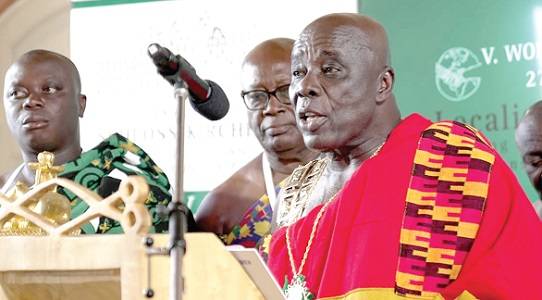
To assist in achieving the UN Sustainable Development Goals, the Okyenhene, Osagyefuo Amoatia Ofori Panin, has advocated for the empowerment of women at all stages of development (SDGs).
He asserted that no economic growth paradigm within the context of the SDGs could be realised without women's empowerment and involvement in the growth process because they make up more than half of the world's population.
The majority of workers in the agricultural industry and other enterprises are women, according to the Okyenhene, who also emphasised the need of giving them the chance to realise their full potential and help in the advancement of the country.
Last Tuesday, Osagyefuo Ofori Panin said, "Over the years, we have given lip service to gender equality." He was speaking at the fifth World Organic Forum in Kirchberg/Jagst, Germany.
"Localising SDGs: Creating a global network of regions on organic soil" is the topic of the four-day event.
It aims to localise the SDGs' implementation and concentrates on creating a worldwide network of SDG areas to make it easier for the 17 objectives to be anchored locally.
Participants come from Ghana, Germany, Norway, Spain, Hohenlohe Region, India, Italy, Tanzania, Uganda, Romania, and Bangladesh.
Concerns
The Okyenhene claimed that there were still oppressive acts committed against women and that in certain nations they were even "unwanted, undesired, and unaccepted. Boys and girls do not have equal access to school, healthcare, or employment opportunities.
"The issue of women in development and leadership must be addressed if the world is serious about advancing justice and eradicating poverty." The Osagyefuo Ofori Panin stated that women were responsible for between 60 and 80 percent of food production in emerging economies while discussing the role and contribution of women in the development of indigenous organic agriculture.
"Women are typically at a disadvantage when it comes to productive assets, land ownership, control of productive inputs, and loan access.
In our region of the world, women have been the driving force behind organic agriculture, although female farmers earn less than their male counterparts, he continued.
However, he was pleased that the greater cost of organic goods was reducing the salary gaps that existed between men and women.
youth participation
The Okyenhene urged young people to take an active role in things, understanding that leaders were trustees of future generations. He urged leaders, parents, and guardians to assist safeguard, plan for, and mould a brighter future for children, saying that "all of us must care about intergenerational parity and justice."