


Ghana's population of nearly 30 million is served by roughly 100 ophthalmologists. This implies that there are around 300,000 persons per ophthalmologist.
The nation had 1,525 eye health experts as of the middle of 2021, which corresponded to a 1:20,196 ratio based on the population at that time.
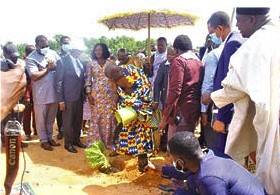
The ground was broken last Tuesday for the construction of a $1 million ocular, surgery, and training centre for the Cape Coast Teaching Hospital (CCTH) in order to bridge equity and access gaps in eye care services.
The facility will improve access to eye care services for the Central and Western areas. It is funded by the Hamalayan Cataract Project (HCP) and being carried out with assistance from the United States Agency for International Development (USAID) and ASHA Foundation.
It is being built as part of the Himalayan Cataract Project and the National Cataract Outreach Programme, and its objectives include bridging the equity and access gaps in cataract procedures as well as generally providing effective eye care services with special packages for the poor.
The centre, which is the result of a four-year partnership between CCTH and HCP and is anticipated to be finished in 18 months, will also act as a training facility for eye care specialists.
After the first one was built at the Komfo Anokye Teaching Hospital in 2014, this one is the second of its kind.
Important: clear eyesight
According to Kwaku Agyeman-Manu, the minister of health, everyone's eye health and clear eyesight are crucial for the socioeconomic growth of any country.
According to him, 1.2 million individuals in Ghana had vision impairment and needed medical assistance.
He said that of the total, blind persons made up 20% of the population and those with limited eyesight made up 80%.
According to Mr. Agyeman-Manu, untreated cataract accounted for 55% of causes of blindness, untreated glaucoma for 19.4%, and the remainder was made up of posterior segment disorders such diabetic retinopathy and reasons associated to the cornea.
He expressed concern that 95% of patients with refractive error who needed to wear glasses did not do so and that roughly 50% of those who had cataracts were unaware that surgery may be used to correct them.
After approving the global Visual 2020 proclamation in October 2000, he pointed out that Ghana has achieved significant advancements in its efforts to combat blindness and vision impairment.
The partnership between the CCTH and the HCP, which started in 2019, has resulted in 4,731 cataract procedures to help individuals regain their vision, according to Dr. Benedicta Thompson, Head of the Eye Unit at the CCTH.
But she said that 35,000 or more people had undergone cataract surgery after being tested for the condition. He urged well-meaning Ghanaians and business organisations to assist the project.
Dr. James Addy, the HCP country representative, stated that HCP will continue to work with other organisations to ensure that as many Ghanaians as possible had better eye health.
superior medical treatment
The Central Regional Minister, Justina Marigold Assan, praised the hospital for its effectiveness and high-quality medical care, and she promised the assistance of the regional coordinating council for the project's successful conclusion.
Ehunabobrim Pra Agyensiam, the chairman of the CCTH Board, who presided over the event, asked individuals who could afford cataract procedures to contribute to support the cause.