


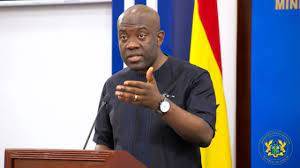
The government cannot acknowledge that it has mishandled the economy, according to Kojo Oppong Nkrumah, Minister of Information, since that is untrue.
The facts that were readily available between 2017 and 2019 plainly show that the economy was performing well, he claimed.
When asked why it is challenging for economic managers to acknowledge that there has been some degree of mismanagement, he responded, "Because you don't admit something is not true, you will have to look at the hard data," on Wednesday, July 6, at the 3businesscolloquium organised by Media General in Accra. You try to explain it with a story, but it doesn't take the fact. Take a look at the Ghanaian economy between 2017 and 2019.
The Ghanaian economy has faced structural issues with the overall economy as well as issues with the fiscal system. Even the way monetary policy addresses the issue of inflation is under debate.
In a recent interview with TV3, Mr. Oppong Nkrumah stated that the circumstances that drove the Akufo-Addo administration to request assistance from the International Monetary Fund (IMF) are entirely different from the circumstances that prevailed when Ghana first approached the Fund in 2014–15.
He clarified that the issue is not with local economic management, but with a global phenomenon brought on by a crisis that has eroded the buffers of over a hundred nations, including Ghana, and forced them to act.
When asked about the notion that the New Patriotic Party (NPP), which was in opposition at the time the John Mahama administration sought assistance from the IMF, was being mocked for turning to the Bretton Woods institution, Mr. Oppong Nkrumah, a lawmaker for Ofoase Ayirebi, told TV3's Paa Kwesi Asare Asare that "when you self-induced crisis and then you have to go to the Fund for a balance of payment support.
But this is not a circumstance in which you have created a problem for yourself. This is a whole different situation. It has nothing to do with how you run your domestic economy; rather, it has to do with a global phenomenon brought on by a crisis that has forced you to act because your safety net has been compromised.
"For instance, starting in 2020, roughly half of the countries in the globe will submit support requests to the Fund. Not that anybody in charge of any of these more than one hundred economies doesn't know how to do their jobs; yet, is it clear that something exogenous, external, has struck today, explaining why Egypt and Kenya, for example?
When questioned once more about whether this choice had humiliated the administration, he responded, "The factors that have brought us here are fairly apparent.
"If you look at the performance of Ghana's economy between 2017 and 2019, yes, there were still some structural challenges in Ghana's economy, but the economy was performing significantly better as a result of the administration's implementation of fiscal and monetary policy measures as well as more comprehensive economic policy measures.
The outcomes were that we were performing better, that the inflation rate and interest rates were declining, and that we had the chance to expand the number of employment and economic development initiatives.
That halted in 2020, mainly because many economies throughout the world, not just our own, were affected by a significant external issue when our economy was still struggling. As a result, even though we had used up a significant portion of our buffers and reserves by 2021, you'll see that we were still working to improve ourselves, restore our reserves, and get our economy moving again.
"Then, in the first few months of 2022, I believe in February, you had what happened in the Black Sea region, causing the globe to experience yet another serious catastrophe. Currently, there are high gasoline prices, high finance costs, and high food prices worldwide.