


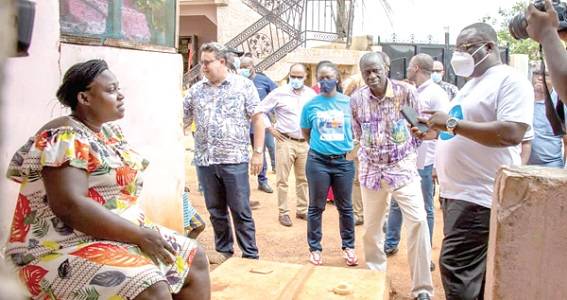
Ousmane Diagana, the vice president of the World Bank for Western and Central Africa, has praised Ghana for its efforts to provide home toilet facilities for low-income communities to improve decent living.
According to him, poverty can be seen or experienced in a variety of ways, including the inability to access certain services that add to a person's dignity.
During a field trip to Adiebeba, one of the Kumasi metropolis's neighbourhoods receiving benefits from the Greater Kumasi Metropolitan Water and Sanitation Project, Mr. Diagana made the observation (GKMA SWP).
The World Bank provided funding for the project in the form of a $125 million credit facility, which is being carried out by the Ministry of Sanitation and Water Resources.
Mr. Diagana said that "in urban areas also there is poverty, and this poverty may be felt in various ways, including the absence of access to some services," and that the initiative was giving the people the much-needed help "particularly with access to water and sanitation."
Support
He said that the project's sanitation component will assist more than 300,000 people, while the water component would also benefit more than 200,000 people.
Given the significance of the project and the need for the public to have access to this kind of service, the bank has committed more than $125 million in it. Accordingly, Mr. Diagana added, "We will undoubtedly continue to offer support as needed."
Background
The World Bank gave the government permission Ghana use an extra credit facility to expand the Greater Accra Metropolitan Area Sanitation and Water Project to the Ashanti Region after it was successfully implemented from August 2014 to December 2020.
The GKMA SWP, which began in April of last year, aims to give 120 institutions and 30,000 families access to better sanitary facilities, including water delivery.
Eight districts that have been designated as flagship locations are where it is being implemented. Ejisu, Kumasi, Asokwa, Kwadaso, Oforikrom, Asokore-Mampong, Suame, and Old Tafo are among these districts.
George Asiedu, the GKMA SWP's project coordinator, said that after eight months of operation, the project has constructed 2,417 upgraded home toilets for more over 19,500 low-income clients, with 55% of them.
Appreciation
One of the project's recipients, Maame Yeboah, was extremely grateful to the project's backers for giving her family a convenient location at a reasonable price.
She said that her family's living circumstances had improved.