

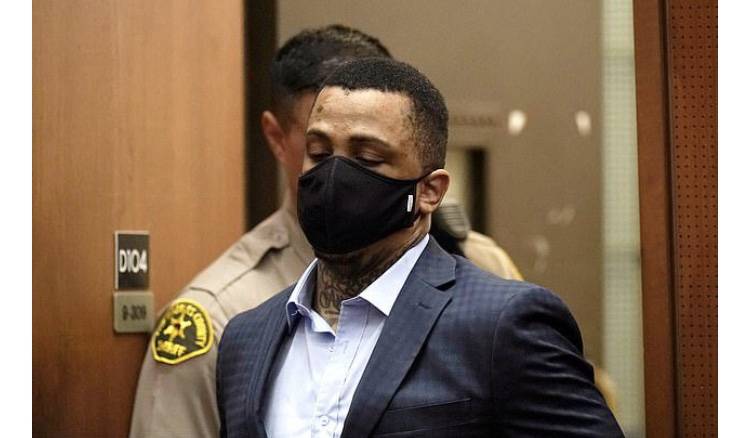
Eric Ronald Holder Jr., 32, has been convicted for the murder of Grammy-nominated rapper Nipsey Hussle on Wednesday.
Holder was charged with murder and two counts of attempted murder in the 2019 shooting of Hussle, 33, outside the singer's Los Angeles clothing store.
Meeting for less than an hour on the second day of deliberations, the jury agreed that Holder planned the murder after a dispute with Hussle, who allegedly spread rumors that Holder was a snitch.
Holder stood up in the small courtroom next to his lawyer as the verdict was read. He had no visible reaction.
Holder faces up to life in prison, where he had already been allegedly jumped by inmates last week, according to his attorneys.
The evidence against Holder was overwhelming, from eyewitnesses to surveillance cameras from local businesses that captured his arrival, the shooting, and his departure.
His attorney did not even deny that he was the shooter but urged jurors to find him guilty of the lesser charge of voluntary manslaughter.
The shooting followed a conversation the two men had about rumors that Holder had been acting as an informant for authorities.
Holder's lawyer Aaron Jansen said that being publicly accused of being a 'snitch' by a person as prominent as Hussle brought on a 'heat of passion' in Holder that made him not guilty of first-degree murder.
'This is a provocation that stirs up rage and powerful emotion,' Jansen told jurors Thursday during closing arguments. 'Mr. Holder Jr. took it seriously, as it was. He knows the consequences of being called a snitch in this manner.'
The issue of 'snitching' has hung over the entire case, not only as the alleged motive but in the reluctance to testify of prosecution witnesses, one of whom, Hussle's friend and shooting eyewitness Evan 'Rimpau' MacKenzie, failed to appear despite a subpoena and a bench warrant.
Deputy District Attorney John McKinney argued during the trial that Holder and everyone else in the conversation that preceded Hussle's death was so calm that the 'snitching' conversation could not have been the primary motive, and that Holder must have had some previous envy or hatred for Hussle.
Hussle, a vocal member of the Rolling 60s gang, was shot 11 times. Two other men were shot and injured in the incident.
McKinney told jurors that the nine minutes between the conversation and the shooting allowed more than enough time for the killing to be premeditated, a requirement for first-degree murder.
The jury agreed.
The conviction came a week after Holder was allegedly assaulted by fellow inmates at a Los Angeles prison where he was held while awaiting trial.
Holder had appeared in court with swollen eyes and three staples closing a wound in the back of his head.
He was punched and cut with a razor by two inmates while waiting in a holding cell to come to court his attorney Aaron Jansen said. The holder is said to have lost consciousness during the attack.
Hussle, whose legal name is Ermias Asghedom, had just released his major-label debut album, which earned him his first Grammy nomination when he was gunned down.
He was a widely beloved figure in Los Angeles, especially in the South LA area where he grew up and remained after gaining fame, buying property, and opening businesses.
'He wanted to change the neighborhood,' McKinney said in his closing argument. 'He kept the same friends. And the neighborhood loved him.
'They called him Neighborhood Nip.'
Hussle was mourned at a memorial at the arena then known as Staples Center and celebrated in a performance at the Grammy Awards that included D.J. Khaled and John Legend.