


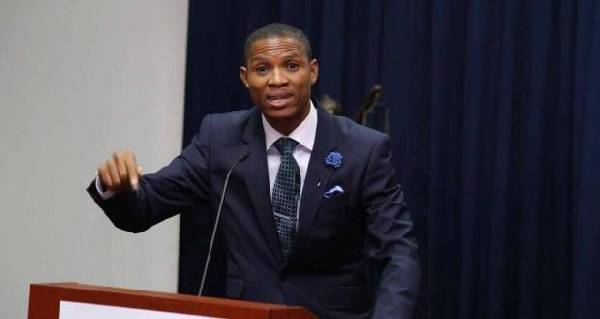
The Death Penalty Bills, generally known as the Criminal and Other Offenses (Amendment) Act 1960 Act 29 and Armed Forces (Amendment) Act 1962 Act 105, proposed by Member of Parliament for Madina Francis-Xavier Sosu, have been gazetted.
To give effect to the recommendations of the 2010 Constitutional Review Commission and Government White Paper on the abolition of the Death Penalty, the Bills that seek to amend sections 46, 49, 49a, 180, 194, and 317a of the Criminal and Other Offenses Act, 1960 (Act 29) and sections 14, 15, 16, 17, 19, 20, 40, 78, and 79 of the Armed Forces Act, 1962 (Act 105) were gazetted on Tuesday, June 28 2022.
In discussing significant country developments in Ghana, Amnesty International's Global Report for 2021 noted that "a Private Member's Bill, proposed to Ghana's Parliament in June by the Madina MP provides for the abolition of the death penalty, as a first step, from the country's Criminal and Other Offenses Act."
The proposed Bill was being prepared for a first reading at the end of the year, and negotiations were taking place to include elements of the Armed Forces Act that impose the death sentence.
According to the most recent figures in Ghana, there would be 165 convicted criminals serving death sentences by the end of 2021, including six foreigners and 159 males and six women.
According to Amnesty International, a minority of nations are increasingly using the capital penalty. Global executions have climbed by 20% since 2020 (from at least 483 to at least 579) while the number of confirmed death sentences has increased by approximately 40%. (from at least 1,477 in 2020 to at least 2,052 in 2021).
Francis-Xavier Sosu claims that "the death penalty being a part of our laws inflicts not only intense psychological suffering and torture on accused individuals and assassination personnel, but also reeks of traditions of primitive countries."
Given this, it is important to note that Ghana has not executed anybody since 1993. Sections 46, 49, 49A, 180, 194, and 317A of the Criminal and Other Offenses Act of 1960 must thus be amended (Act 29). The death clause needs to be removed from our laws as a nation.
The Supreme Court of Ghana's Justice Dotse JSC stated in 2011 that "the moment has probably come for the Parliament of Ghana to carefully examine whether to have a policy adjustment in the obligatory death penalty system enforced." The case was Dexter Johnson v. the Republic [20111 2 SCGLR 601@P702].
The United Nations General Assembly (UNGA) plenary session saw a record number of states (123) support the adoption of its biennial resolution calling for the establishment of a moratorium on executions with a view to fully abolishing the death penalty in December 2020. This is an increase of 19 votes from 2007, when the first UNGA resolution on this issue was adopted.
If the Private Member's Bill introduced by Mr. Sosu is enacted, Ghana will abolish the death sentence in at least 95% of cases, joining neighbours such as Sierra Leone, the Central African Republic, Guinea, Benin, Cote d'Ivoire, Senegal, Togo, and Chad as the 25th African nation to do so.