


It is now official that the Ghanaian government has started talking to the International Monetary Fund (IMF) about receiving financial assistance.
According to the administration, the engagement would aim to offer a Balance of Payment Support (BOP) as part of larger support for a build-back of the economy in the face of difficulties brought on by Covid-19 and the Russia-Ukraine situation.
According to current statistics from the Bank of Ghana (BoG), Ghana's foreign reserves have decreased from USD $9.7 billion at the end of 2021 to USD $8.3 billion.
At the same time, Ghana's debt increased to 78% of GDP as of the end of March 2022. Inflation is reported to be 27.6%, an 18-year high, and is mostly attributable to the rise in food and transportation costs.
With the release of this formal notification, the last bailout package was completed three years ago, making this the second bailout from the same institution since 2015. With this development, a number of questions curiously come to mind.
Prioritizing agriculture
It is vital to ask: What were the aims of the earlier bailout and how well were they implemented in regard of sustained economic impact? While avoiding the customary partisan political argument sparked by the development. Which investment sectors will lead to genuine sustained recovery and expansion heading into the following engagement?
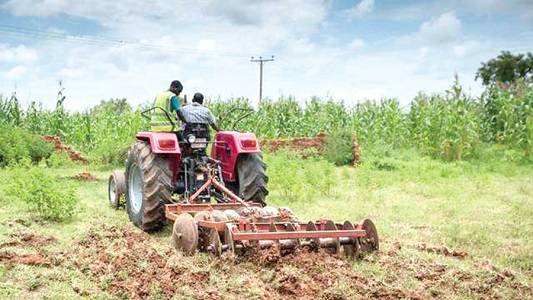
In response to the latter query, I would vehemently argue that the central government should prioritise investment in the agriculture sector to promote genuine sustained recovery and growth heading into our upcoming discussion.
There is historical evidence of the link between agricultural and long-term economic growth, as well as evidence from the successes of many industrialised nations.
highest standards
The Green Revolution in Asia put the spotlight on agriculture's ability to spur economic expansion. According to the Food and Agricultural Organization (FAO), the agricultural industry accounts for over 52% of the workforce and about 25% of GDP in many developing nations like Ghana. Three crucial jobs that agriculture plays in the process of economic growth—the roles of product, factor, and market—justify prioritising and funding the agricultural sector as a must for economic recovery and growth.
necessary actions
The agriculture sector's output has a dual purpose in feeding the people and generating foreign exchange when agricultural products are exported to other nations.
In the theory of the food crisis, the product role is crucial. Since the majority of people in low-income countries must spend a significant portion of their income and labour on buying food, these nations are unable to progress.
Simply expressed, a country can only further develop itself and begin a process of contemporary economic growth once the productivity in the agricultural sector has improved and agricultural production has expanded. This clearly establishes the causal relationship between gains in agricultural production and economic growth.
In agriculture, the term "factor role" refers to the provision of capital and labour to other industries and service sectors. The dual-sector method shows that there is a difference in labour productivity between the agricultural (subsistence) sector and the non-agricultural sector.
As a result, economic growth in emerging nations can't really take off as long as labour is allocated to industries with low labor's marginal output. include agriculture. The demand for (domestic) industrial production rises as a result of greater agricultural productivity, which also raises the income of the rural people.
The market function also mentions agriculture as a distribution channel for goods from the industrial industry. Increases in agricultural production support economic growth through this market function.
Industrialization driven by agricultural demand expands on the function of the market. A development strategy that relies on export-led industrialization is less favourable for the development of economies than one that is focused on agricultural demand-led industrialization.