


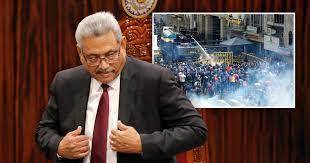
In the midst of widespread protests over the island's economic woes, President Gotabaya Rajapaksa left Sri Lanka on a military plane.
The 73-year-old, together with his wife and two security personnel, took a flight to the Maldives, according to the country's air force.
He has named Ranil Wickremesinghe, the prime minister, to serve as president in his absence. With Mr. Rajapaksa's departure, a political dynasty that has governed Sri Lanka for the past 20 years comes to an end.
After large crowds attacked his home on Saturday, the president fled and announced his intention to step down on Wednesday, July 13.
According to a source who spoke to the BBC, Mr. Rajapaksa will not stay in the Maldives and instead plans to continue on to a third nation. Former Finance Minister Basil Rajapaksa, who is also his brother, has reportedly departed Sri Lanka and is on his way to the United States.
Thousands of people flooded Colombo's streets as Sri Lankans awakened to the news. At Galle Face Green, the city's primary protest location, many people gathered. On a temporary platform made up for speakers of the people to grab the mike, some people listened to ferocious speeches.
The rallying cry of the protest movement, "Victory to the struggle," was used as a punctuation mark as speakers lashed out at a government and its officials they believed had let them down.
Ranil Wickremesinghe, the prime minister of Sri Lanka, has ordered a curfew in the western region and proclaimed a state of emergency nationwide. Police have used tear gas to disperse a group of demonstrators who were moving toward parliament and the prime minister's office.
Some protesters were incensed by Mr. Rajapaksa's departure because they saw a lack of responsibility.
"We disagree with it. We intend to retain him. We need our cash back! And we want to lock up the entire Rajapaksa family in an outdoor facility where they may work on farms, according to protester GP Nimal.
Reshani Samarakoon, a 23-year-old university student, told the BBC that the former president's exile gave her "hope that ultimately we may become a developed country, both economically and socially."
Sri Lankans attribute their greatest economic catastrophe in decades on President Rajapaksa's government. They have been enduring daily power outages and shortages of necessities like fuel, food, and medications for months.
The leader is thought to have intended to leave the country before resigning in order to escape the prospect of being arrested by the next administration as he is immune from prosecution while he is president.
The departure of the president raises the possibility of a power vacuum in Sri Lanka, which requires a functioning administration to start the country's process of financial recovery.
A new unity administration has been discussed by politicians from other parties, but there is currently no indication that they are close to reaching an agreement. Whether the general people would accept what they come up with is another question.
According to the constitution, if the president were to step down, the prime minister, Ranil Wickremesinghe, would take over. In parliament, the prime minister is referred to as the president's deputy.
But Mr. Wickremesinghe also has a poor reputation. He and his family were not inside when protesters set fire to his private property on Saturday, but he said that he will step down to make space for a unity administration but did not provide a timeline.
The next most probable candidate to serve as acting president, according to constitutional experts, is the speaker of the parliament. However, because Mahinda Yapa Abeywardena is a Rajapaksa friend, it is uncertain if the general populace would recognise his authority.
Whoever does end up in the role of acting president has 30 days to call a vote among parliamentarians to pick a new leader. The victor of the poll might finish Mr. Rajapaksa's remaining term until late 2024.
Sajith Premadasa, the head of the major opposition, announced to the BBC on Monday that he will be running for president. But he also receives little popular backing, and the public has a strong mistrust of politicians in general.
There is no clear front-runner for the position of leader of the country amid the protest movement that has taken Sri Lanka to the verge of change.