


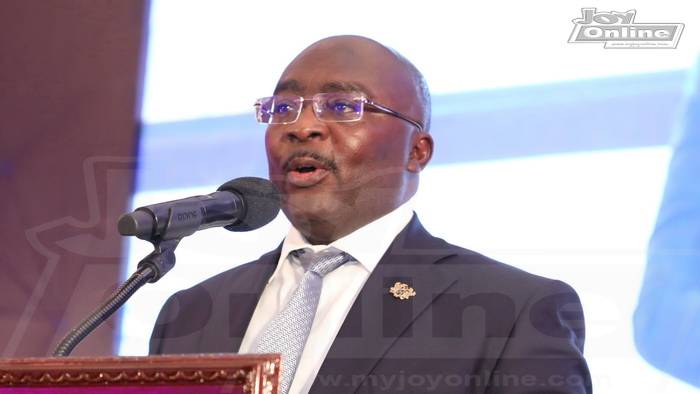
Vice President Dr. Mahamudu Bawumia claims that "the former government" is partially to blame for some of Ghana's present economic difficulties.
He claims that the "quadruple whammy" the government is currently dealing with—excess capacity payments, the financial sector crisis, COVID-19, and the Russia-Ukraine war—is to blame for the current issues.
He said that the surplus capacity payments and the financial sector issue, two of the four reasons, were left over from the previous government.
This assertion was made by Dr. Bawumia during a speech on Thursday at the Accra Business School. The significant growth in Ghana's debt stock by the end of 2021, he claimed, was not the result of COVID-19 spending alone.
If the fiscal effects of this triple whammy are removed, Ghana won't need assistance from the IMF since the prognosis for its finances, debt, and balance of payments would be stable. Two of the four factors—COVID-19 and the Russia-Ukraine war—were caused by foreign events, and the other two—the cleaning up of the banking system and the excess capacity payments—were the outcome of earlier administration initiatives.
He provided arguments for why the NPP administration should not be held accountable for the current economic crisis.
"Allow me to illustrate my idea with an analogy. Will you not hold the carpenter responsible if you hire him or her to roof your home and then, out of the blue, the roof falls without any wind or precipitation? But will you blame the carpenter if he builds your roof and it collapses due to a tornado and a storm that also sweeps away several houses' walls, windows, and roofs? said Dr. Mahamudu.
According to Dr. Bawumia, the government has spent more than GHS54 billion on excess capacity payments in the energy sector, the banking sector crisis, and Covid-19, but only GHS15.62 billion on its signature initiatives, including Free SHS, One District, One Factory, Planting for Food and Jobs, Development Authorities, Ghanacard, Zongo Development Fund, NABCO, and teacher and nursing trainee allowances.
The vice president also emphasised the necessity of IMF assistance and the effects of the Covid-19 epidemic and the Russia-Ukraine war on the economy.
"In addition, investors withdrew $50 billion from emerging market bond funds in 2022 alone as a result of rising interest rates in Western nations and elevated perceptions of risk in emerging market economies. Bonds held by non-residents in Ghana were not being renewed, which caused a fall in foreign exchange reserves as repatriations rose. Balance of payments support was required due to the difficulties in gaining access to the global capital market in order to close the funding gap, stabilise the economy, and free up time for the adoption of structural reforms and the restoration of debt sustainability. Thus, we decided to ask the IMF for assistance," the Vice President remarked.