


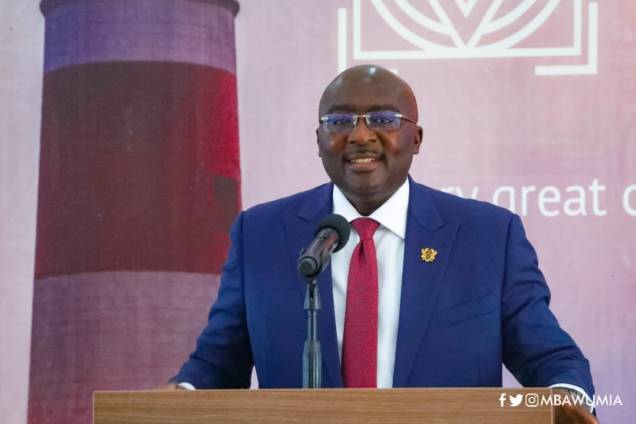
According to Vice President Dr. Mahamudu Bawumia, Ghana has experienced a triple whammy in recent years, prompting the need for the government to apply for IMF assistance (IMF).
Dr. Bawumia said that if it weren't for the budgetary consequences of this triple whammy, the nation wouldn't be turning to the IMF for assistance.
He said that the country's need for the Bretton Woods institution's assistance was prompted by the Russia-Ukraine war, COVID-19, excess capacity payments in the energy sector, and the clean-up of the banking sector.
Dr. Bawumia said, "The excess capacity payments of GHC 17 billion relate to a legacy of take or pay contracts that saddled the country's economy with annual excess capacity charges of close to US$1 billion." He was speaking at the Accra Business School on Thursday, July 14, under the theme, "The Role of Information Technology Education in the Government's Digitalization Agenda."
According to Dr. Bawumia, these agreements essentially provide for the provision of electricity to Ghana in excess of that country's needs, but we are still responsible for paying for that energy whether Ghana utilises it or not.
He stated that the excess capacity payments include GHC 7 billion in gas payments from the previous administration's signing of an offtake deal for a specific amount of gas with ENI Sankofa on A take-or-pay basis was used, which was far more than was necessary at the time.
Failure to make the excess capacity payments on time would have meant a fresh outbreak of dumsor for the nation.
According to Dr. Bawumia, the country is also dealing with a banking crisis as a result of the poorly run banking industry.
He said that if Ghana's banking system hadn't been dealt with swiftly, the country's economy would have suffered and millions of people's money would have been lost.
Direct COVID-19 spending was GHC 12.0 billion, divided into GHC 8.1 billion and GHC 3.9 billion in 2020 and 2021, respectively. He stated that the three expenditures totaled GHC 54.0 billion (about $7 billion in US dollars), all of which was borrowed.
According to the Ministry of Finance, the yearly interest payments on these three items' borrowing total GHC 8.5 billion. According to him, this represents almost 23% of Ghana's yearly interest payments of GHC 37 billion.
It should be highlighted that Ghana's debt to GDP would be under the sustainability criterion of about 68 percent rather than the 76.6 percent at the end of 2021 if not for the GHC 54.0 billion debt for the three special items (COVID-19, Financial Sector, and Energy).
If the fiscal effects of this triple whammy are removed, Ghana won't need assistance from the IMF since the prognosis for its finances, debt, and balance of payments would be stable.
"Of the four variables, two—COVID-19 and the conflict between Russia and Ukraine—were caused by foreign events, and the other two—the cleanup of the banking system and the excess capacity payments—were the outcome of prior administration initiatives."
Way ahead
Unfortunately, there is no end in sight for the Russia-Ukraine war, Vice President Bawumia remarked when asked about the country's future. Even while we hope the conflict will end quickly, we must be aware that things may grow worse before they get better.
We need to be more independent as a nation, he added, citing the previous two years as the main lesson. Whether or whether we request a programme from the IMF, it is crucial that we make choices that will benefit the nation as a whole.
Dr. Bawumia asserts that the nation's urgent objective is to restore fiscal and debt sustainability through revenue and spending measures and structural reforms. He also states that "non-concessional borrowing should be reduced to promote debt sustainability."