


 Globally, marriage is central to family life and the continuity as well as the sustainability of the human race, even though procreation occurs without marriage and marriage may also exist without procreation.
This might be the reason for Nukunya’s assertion that “marriage is the recognised institution for the establishment and maintenance of family life all over the world” (Nukunya, 1992: 3).
Definition
No universally accepted definition of marriage exists; hence, numerous definitions have been assembled in literature for this social institution. From the Ghanaian customary law perspective, marriage has been regarded as an intimate union between a man and a woman. The potential couple must go through the approved societal processes to become marital partners. Marriage is still regarded as valid, whether it produces biological children or not.
In Ghana, the marital relationship is not only exclusively between the husband and wife but it also binds the spousal families of both sides who have become affinal families usually referred to as in-laws (Nukunya, 1992; Sarpong, 1974).
Dowry
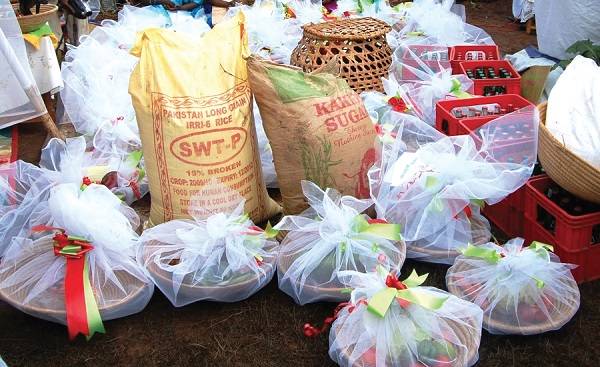
Worldwide and in different forms, marriage comes at a price called the bride price, which is usually quoted in cash and/or in kind. Suffice it to say marriage goes through certain societally approved processes to become valid and acceptable by the affinal families involved.
In Ghana, the bridal family determines the bride price and duly communicates the same to the groom and his family. The bride price also called dowry is usually not negotiable. The groom must mandatorily pay the dowry if he really wants to marry the bride. What constitutes the dowry varies “from society to society and sometimes within the same ethnic group, local differences are found” (Nukunya, 1992: 39).
Usually, the dowry is segmented depending on the stage of the process involved. Initially, non-refundable items are required of the groom to inform the bride’s family about his marital intentions. The Ashantis generically refer to these informative items as tiri nsa (head wine) whereas Anlos call it tabianu (request items). Among the Tongu Ewes with a special focus on Mepe Traditional Area, the dowry is segmented into three parts namely knocking drink (Ʋuɔƒoha), informative items (Namanya) and the main dowry (azieha or aziehaga). Without aziehaga, the bride’s family tends to have more parental rights over the biological children of the marriage.
Expensive dowries
As we indicated earlier, dowry payment is mandatory for the groom and without it, the union is deemed a mere cohabitation in customary law. In contemporary Ghana, some families are charging huge sums of money aside from numerous items as bride price.
In most cases, bridal families receive the cash equivalence for non-cash items such as drinks and cloth. This makes the marriage list very expensive for young men who are interested in a lady. It is as if the bridal family is “selling” its daughter to the groom. This might be the reason why some husbands abuse their wives in divergent ways. Perhaps they assume that the expensive dowry is tantamount to the “purchase” of the bride from her family.
In case the groom is not financially stable, the marriage struggles for years because some grooms even take bank loans to be able to pay the dowry. In that case, the husband in the new marriage has debts to settle and at the same time, he is required of performing his financial duties in the marriage.
No regulation
Currently, Ghana has no law regulating bride price collection. Families use their discretions to charge grooms and some families are taking advantage of the situation. In fact, exorbitant dowries tend to place enmity between some brides and their own families. This is because some brides feel that their families charge too much for a dowry.
Perhaps another annoying aspect of the whole show is that because the marriage is contracted between the groom’s and the bride’s families, and the bride price is mandatory, even family members who were not responsible financially for the bride’s upbringing tend to be the ones to charge huge bride prices.
In cases where both the groom and the bride love each other and are bent on building upon their intimate cohabitation, the union continues even with procreation without the bride price. However, this tends to worsen the plight of the groom, especially whenever the woman dies before the man.
We had witnessed some bridal families insisting on posthumous wedding ceremonies aside from the demands that the groom should provide most of the burial items. All this is done to punish the man who cohabited with a woman whose bride price he did not pay in her lifetime.
It is high time the Government of Ghana and/or traditional authorities regulated the bride price collection regimes to sanitise the marital space. To this end, Parliament must pass a law on bride price collection just as there is Marriage Ordinance, Wills Act and Intestate Succession Law, all relating to marriage apart from such provisions in the 1992 Constitution. Bridal families have taken enough unfair advantage of grooms and their families.
Traditional authorities can equally establish communal bride price regimes to ensure that there is uniformity and something affordable to potential grooms. Currently, among the Tongu Ewes and other ethnic groups, grooms from a community or a lineage different from that of the bride tend to pay higher bride price than grooms who come from the same community as the brides.
Conclusion
Indeed, marriage comes at a price and this bride price must not be entirely abolished but at the same time, greed must not take a better side of it. Dowry is not the price at which the groom is “buying” the bride. Families are advised to desist from charging exorbitant dowries to make marriage affordable and joyous for young marital couples. Perhaps what aggravates the woes of the groom is that some bridal families demand solemnisation of the marriage. Solemnisation also comes at a cost.
No bride price is worth the worth of a daughter to her family so charging exorbitant dowries is needles and it must be checked.