


 Comfort Oware of Gboloo-Kofi in the Akuapem North municipality had gone to the farm as usual one early morning last year. While working on the farm, she stumbled over a stump and felt a sharp pain.
Although there was no cut, upon getting home, the 72-year-old farmer realised that the affected area of the foot had begun to itch persistently.
After continuous scratches for a few days, a small sore developed, grew bigger and spread across her sole, creating a wound at a spot.
Ms Oware told the Daily Graphic at Gboloo-Kofi, near Adawso, that it was during one of the numerous visits to health facilities in search of treatment that she was diagnosed of Buruli ulcer, a disease she had no knowledge about.
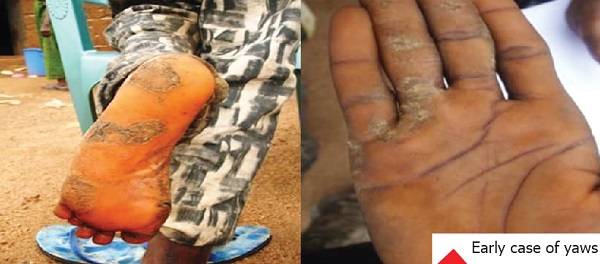
She shared her story when a team from the Daily Graphic visited the Akuapem North municipality, one of the Buruli ulcer and leprosy endemic areas where the Ghana Health Service (GHS) in collaboration with an international non-governmental organisation (NGO), Anesvad Foundation, had embarked on a start-up project to control Buruli ulcer, eliminate leprosy and eradicate yaws.
It is an endemic district because the two diseases are common there due to the lack of potable water in the affected parts of the district, a contributory factor to the transmission.
The diseases are prevalent where there is inadequate water and where people hardly get water even to bath. They are, therefore, known as water-washed diseases.
Buruli ulcer, especially, is likely to affect people where there is slow moving water bodies and the integrity of the soil is disturbed.
The municipality is one of the 15 selected districts in the country where the GHS and Anesvad are fighting three of the Neglected Tropical Diseases (NTDs).
Ms Oware’s story is similar to that of Peter Ankrah, a retiree from New Asuoyaa, also in the Akuapem North municipality.
For Mr Ankrah, in 2007, he noticed patches of skin that were lighter than his overall skin tone all over his body, a condition known as hypopigmentation.
He did not seek medical attention until somebody spotted it and told him it was one of the symptoms of leprosy.
Mr Ankrah said he still did not see the need for medical help until later in 2019 when he saw his fingers and toes getting deformed, then he recalled the conversation in 2007 that it could be leprosy.
At a health facility, it was confirmed that he had leprosy.
Neglected Tropical Diseases
Leprosy, Buruli ulcer and yaws are among a group of 20 conditions known as Neglected Tropical Diseases (NTDs) which are mainly prevalent in tropical areas such as Ghana, and affect over 1.7 billion people.
The transmission thrives on insanitary environments, especially the lack of potable water.
They are called "neglected," because they generally afflict the world's poorest and historically have not received as much attention as other diseases.
night, under a tree in the village under bad weather conditions.
Touched by that pathetic situation, the New Apostolic Church at New Asuoyaa, offered him their premises to live in and that is where he had been ever since.
“He has two children who live in Larteh, grandchildren who live in this village and his wife who resides in the city, but none of them ever pays him a visit,” Ms Sarfo and a volunteer of the programme, Mary Adubea Bekoe, said.
Steps being taken
At the national level, Dr Kotey said under the Anesvad Project, they were raising awareness of the three diseases.
As part of this project, various health workers had been trained on how to treat the disease.
She said various training sessions were also organised for people in communities on how the cases presented themselves and the steps that needed to be taken when they noticed the symptoms.