


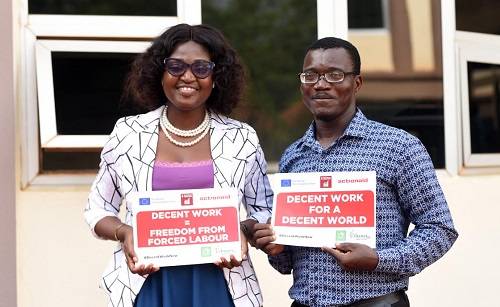
John Nkaw, the country director for ActionAid Ghana, has voiced his worry that many vulnerable individuals, particularly women and young people, are being deprived of their fundamental rights by immoral employment.

He also raised concern about the COVID-19 pandemic's role in making women more vulnerable by uprooting their livelihoods and companies and turning them into prey for exploitation and improper labor practices.
In a statement to mark this year's May Day, Mr. Nkaw urged the government and development partners to intensify projects for the development of livelihood skills in order to assist women and young people in finding secure, respectable alternatives to their current means of subsistence.
The subject for May Day 2023 was "Workers' Rights and Socio-Economic Justice."
The national event in Ghana, for instance, was held in Bolgatanga, the capital of the Upper East Regional, with the topic "Protecting Incomes and Pensions in an Era of Economic Crisis: Our Responsibility."
The first of May has been designated as International Worker Achievement Day.
The International Workers Day message from ActionAid Ghana is provided below: Action Aid Ghana demands the creation of a national strategy to address the lack of decent jobs.
Friday, April 27, 2023, in Accra ActionAid Ghana joins the international community to thank all employees for their dedication to Ghana's development agenda and their selfless efforts to better their own lives and the lives of their families. As a social justice organization, we adhere to the belief that a country's wealth is based on its human resources. We also think that members of the workforce are the driving factor behind national progress.
Ghana has ratified over 46 ILO conventions since it joined the International Labour Organization (ILO) in 1957, demonstrating its commitment to improving working conditions. Aside from these Conventions, the 1992 Ghanaian Constitution, Act 651 of 2003's Labour Act, and Domestic Workers Regulation, 2020 (L.I. 2408) all have provisions that support and defend workers' rights to form unions, work under decent conditions, and protect domestic workers' rights.
Despite these courageous actions taken to protect both formal and informal workers, the implementation of decent work policies has been hampered by a number of issues, such as inadequate workplace safety, wages below the 14.88 minimum wage, and the absence of a social security system or pension plan for retirement.
The frequency of child and forced labor, the right to maternity protection, social protection, and discrimination against women are greater in the rural or informal economy than in the urban or formal economy, despite the fact that these difficulties are documented in both formal and informal work contexts.
The country's ability to fulfill the ILO's decent work agenda, which includes opportunities for productive work, fair income, social protection for families, better prospects for personal development, the ability to participate in decisions that affect their lives, and equality of opportunity and treatment for women and men, is called into question by these pervasive decent work deficits.