


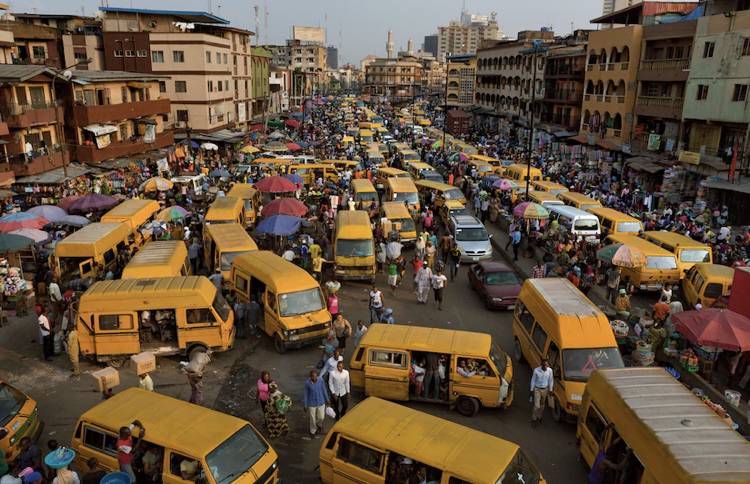

The city is bursting with a get-rich spirit that has made Nigeria’s economy the continent’s largest.

When he was 15 years old, David Adeoti worked in an Internet café in blue-collar Satellite Town, where it was almost possible to see the gleaming towers of Lagos Island less than ten miles to the east.
Satellite Town was a step up for Adeoti. His birthplace was off to the north in Orile, a wretched village of flooded streets and collapsing buildings. Technology had provided his way out. The Internet café in Satellite Town was run as a side business by a banker, who saw that the boy had a natural facility for computers—even the shop’s ancient desktops, which operated at lurching speeds. The banker paid Adeoti a little more than $200 a month to run the place. Adeoti spent his money on courses at a technical institute, determined that the Internet café would not be the end of the line for him.
One day in 2010 the shop’s customers looked up from the computers to see who had just walked in the door with the mannered British accent. His name was Jason Njoku, a bespectacled 30-year-old Londoner who had relocated to his ancestral homeland of Nigeria. Njoku asked Adeoti if he could scan some documents. While Adeoti operated the scanner, the genteel visitor mentioned that he was trying to find investors for a new business venture and asked the Internet café manager if he enjoyed his job. They exchanged cell phone numbers. A few months later Adeoti inquired about a job and was invited to Njoku’s apartment. Adeoti walked inside to find six young men wedged behind desks with computer cables snaked around their feet as they typed. This, Njoku informed Adeoti, was his new business: an indigenous version of Netflix that would stream movies to Nigerian computers and bring Nigerian movies to the world. Njoku needed someone like Adeoti to convert “Nollywood” DVDs into a YouTube format. As was evident by the cramped environs, the project was perilously low on money. Adeoti signed on anyway, thinking, It’s going to sell itself.
At the end of the workday, vans crowd into Idumota Market on Lagos Island to pick up workers returning home to the mainland, where most Lagosians live.
When I met David Adeoti in spring 2014, he was 24 and wearing an elegant knit shirt and designer jeans while sitting behind a Mac laptop in the sleek three-story office that now houses iROKOtv in Lagos. Njoku’s company has about 80 employees, with additional offices in Johannesburg, London, and New York City. Adeoti makes twice the salary he made as the manager at the Internet café. But all this exposure to money and movies had whetted his appetite for more of both. “I plan on starting my own business—something in the film industry,” he told me. He was saving money to travel to Hollywood. He wants to be a cinematographer—and perhaps one day, a Nollywood studio executive.
“It’s a very far distance from middle class to being rich,” Adeoti said. With a widening grin, he added, “But the middle class, we strive. Everyone is very desperate to be very rich these days.”
Almost anywhere else in the developing world, such a sentiment would seem pitiably delusional. In Lagos, Nigeria’s commercial center, “Be Very Rich” has all but become the city’s motto. The country recently recalculated its gross domestic product to take into account sectors of the economy that barely existed two decades ago. As a result, Nigeria determined that its GDP surpassed South Africa’s in 2012 to become the continent’s largest economy. About 15,700 millionaires and a handful of billionaires live in Nigeria, more than 60 percent of them in Lagos.
As with other African metropolises, oil-enriched Lagos has long nurtured an elite class only marginally inconvenienced by the squalor enveloping the city as a whole. Now the upper class is expanding, and despite persistent income inequality, so is the middle class. The growth of the latter in Nigeria, according to a 2013 survey by Ciuci Consulting, a strategy and marketing firm in Lagos, is driven by the expanding banking, telecommunications, and services sectors, particularly in Lagos. Nigeria’s middle class grew from 480,000 in 1990 to 4.1 million in 2014, or 11 percent of households. Seemingly overnight, Lagos has transformed itself into a city of Davids clamoring to become Goliaths.
This is a great African success story. And how lovely it would be to tell this bright, uplifting tale while ignoring altogether the dark and demoralizing saga of Nigeria’s grotesque terrorists, which has blocked the boomtown narrative from the world’s consciousness like a lunar eclipse. But Lagos does not exist in a parallel universe, any more than the Islamic extremist group Boko Haram does. Both are indigenous to Nigeria, a vast West African nation teeming with industrious strivers like Adeoti but also with poverty, despair, and violence. If anything, the miracle of Lagos is that its economy gallops onward even when fettered by the same federal incompetence that allows terrorism to go unchecked. A lesser city would be crippled. Then again, in a sense so is Lagos.